
Deciding between NACLO Invitational Round preparation and the IOLC Academic Exploration Camp depends heavily on your citizenship, school location, and long-term goals for the International Linguistics Olympiad (IOL). Both paths lead to the global stage but operate under distinct eligibility rules and competitive structures.
Understanding the Two Selection Paths
The IOL does not have a single global entry point. Instead, students qualify through national or regional competitions. For students in North America, the path is via NACLO. For students eligible for the Chinese team, the path is via IOLC.
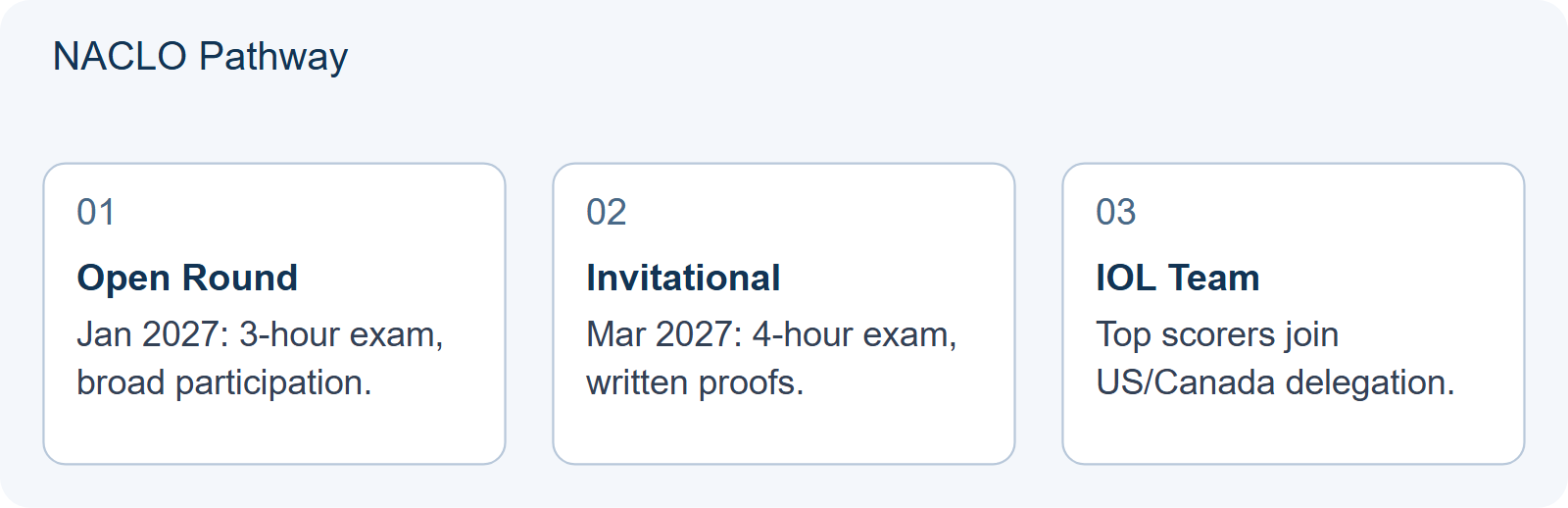
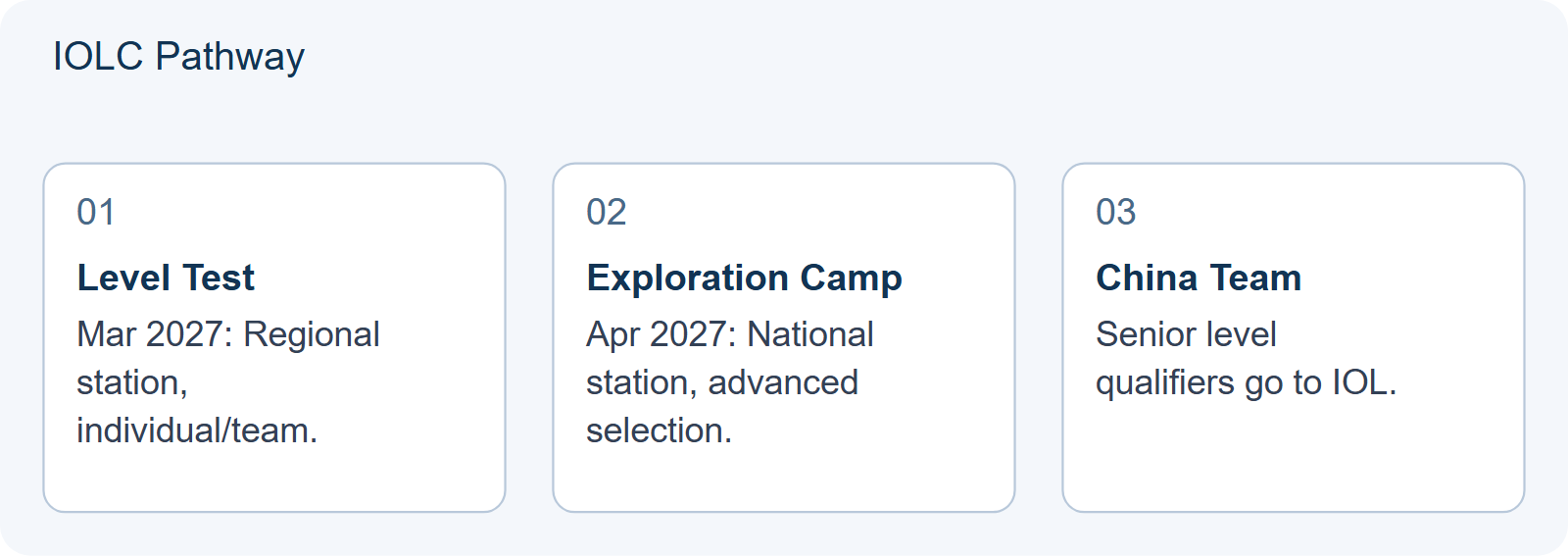
| Feature | NACLO (North America) | IOLC (China Route) |
|---|---|---|
| Eligibility | US/Canada citizens OR enrolled in US/Canada secondary schools. | Students eligible for the China National Team (verification required for overseas students with mainland nationality). |
| Stage 1 | Open Round (Jan 28, 2027): 3 hours, fill-in/short answer. | Level Test / Regional Station (Mar 7, 2027): Individual or team. |
| Stage 2 | Invitational Round (Mar 18, 2027): 4 hours, written reasoning. | Academic Exploration Camp / National Station (Apr 16-18, 2027). |
| Goal | Select top 4-8 US & 4 Canada students for IOL team. | Select China National Team members for IOL. |
Deep Dive: The NACLO Invitational Round
The NACLO Invitational Round is the critical second stage for North American students. Unlike the Open Round, which focuses on speed and pattern recognition, the Invitational demands rigorous written explanation. You must articulate the linguistic rules you discovered. This round determines who represents the US and Canada at the IOL.
Preparation for this stage requires shifting from “solving” to “proving.” Students often struggle because they find the right answer but cannot justify it clearly. Practice writing out your deduction steps explicitly. If two analyses fit the data, learn to test them against edge cases. This skill is vital for high scores in the Invitational.
Deep Dive: IOLC Academic Exploration Camp
For students on the China route, the IOLC Academic Exploration Camp functions as the National Station selection phase. It follows the Level Test (Regional Station). Success here determines eligibility for the China National Team. Note that only Senior Level participants can advance to the international stage.
This stage assesses both individual and team performance. While the Level Test allows for team registration, which offers additional pathways for advancement, the primary objective at the National Station is rigorous evaluation of linguistic reasoning skills. Preparation should focus on building a systematic knowledge base in phonology, morphology, and syntax, rather than just memorizing vocabulary.


Can You Participate in Both?
A common question is whether a student can attempt both NACLO and IOLC. The sources advise caution. Eligibility criteria are strict. NACLO requires US/Canada citizenship or enrollment. IOLC targets those eligible for the China team. If you hold dual qualifications, you must verify which national team you intend to represent. Conflicting commitments may arise, and administrative rules generally prevent representing two different countries simultaneously. Always check current year regulations before registering.
Strategic Preparation Tips
- Start with Past Papers: Use official problems from previous years to understand the difficulty curve. For NACLO, practice explaining your logic in writing.
- Focus on Reasoning: Linguistics olympiads test induction and deduction, not language fluency. Learn to identify patterns in unfamiliar scripts and sound systems.
- Time Management: The Invitational Round gives 4 hours for complex problems. Practice pacing yourself to leave time for review and clear exposition.
Whether you choose the NACLO Invitational Round track or the IOLC path, early preparation is key. Understanding the specific format and eligibility requirements of each competition will help you allocate your study time effectively. Remember, these contests reward logical rigor over rote memorization.
HYPOTHETICAL/ILLUSTRATIVE: Balancing Written Rigor and Speed
To apply the strategic advice from this article, consider a hypothetical student named Alex. Alex is preparing for the next stage of their chosen path. The core decision revolves around how to allocate limited study hours between two distinct cognitive skills: rigorous written exposition (crucial for NACLO Invitational) and efficient pattern recognition under time pressure (relevant for IOLC National Station).
Alex has ten weeks before the first major stage. Two plausible preparation strategies emerge. Strategy A involves dedicating 80% of time to solo problem-solving followed by writing detailed, paragraph-length justifications for every solution, mimicking the NACLO Invitational’s demand for explicit reasoning. Strategy B involves spending 60% of time on timed drills, practicing quick verbal pattern identification and concise notation, aligning with the efficiency required in competitive exams.
| Decision Factor | Strategy A: Written Rigor Focus | Strategy B: Efficiency & Speed Focus |
|---|---|---|
| Primary Skill Built | Clarity of written deduction; handling edge cases alone. | Speed of pattern recognition; concise articulation under pressure. |
| Risk if Mismatched | Slow pace during timed rounds; running out of time. | Vague explanations in written finals; losing marks for lack of proof. |
| Best Fit For | Students who solve quickly but struggle to explain “why.” | Students who write well but are too slow to finish the paper. |
The decision changes based on Alex’s diagnostic results from past papers. If Alex consistently finds the correct answer within 15 minutes but loses points because the written explanation lacks logical connectors or fails to rule out alternative hypotheses, Strategy A is superior. This directly addresses the NACLO Invitational’s requirement to “prove” rather than just “solve.” Conversely, if Alex struggles to finish the paper because they spend too long verifying every minor detail, Strategy B builds the necessary pacing discipline.
In this illustrative scenario, Alex chooses Strategy A after realizing that while they enjoy fast solving, their scores drop significantly in sections requiring detailed justification. They adjust their routine: instead of solving five problems per week, they solve three, but spend an additional hour rewriting their solutions as if explaining them to a judge who knows nothing about linguistics. This practice forces explicit articulation of implicit assumptions, a key differentiator in high-level competition scoring.
Readers can use this reusable self-check: Take one recent practice problem you solved correctly. Without looking at your notes, write a full justification for your answer. Then, have a peer read it. Ask them: “Did you understand exactly why my answer was right, or did you just guess?” If they guessed, your preparation needs more focus on explicit reasoning structure. If they understood immediately, shift focus to speed or complex pattern recognition. This simple audit helps determine whether your bottleneck is discovery or communication, guiding your choice between intensive proofing or timed drills.
Deciding between NACLO’s invitational rounds and IOLC’s academic camps requires understanding distinct preparation goals. For those balancing international curricula, see Linguistics Olympiad Alongside IB, A-Level or AP. To assess your current readiness objectively, try the 45-Minute Linguistics Olympiad Self-Diagnostic. Finally, grasp the structural differences in training intensity by reviewing From Three Hours to Six: What Actually Changes Between a National Round Paper and an IOL Paper.
Frequently Asked Questions
Who is eligible for the NACLO Invitational Round?
You must be a US or Canadian citizen, or enrolled in a secondary school in the US or Canada. You also must be under 20 on the first day of the IOL and never enrolled full-time in college.
What is the main difference between IOLC Junior and Senior levels?
Junior is for beginners with less linguistic background. Senior is more difficult and is the only level that allows advancement to the IOL International Station.
Can I prepare for both NACLO and IOLC simultaneously?
It is generally discouraged due to conflicting schedules and eligibility restrictions. You typically qualify for one national team based on citizenship or school location. Verify your specific status before registering.
Keep reading.
IOLC Consonant Digraphs: Why bh, mb and ng Stay Single Units in Rongga-Style Data
In the 2026 IOLC Newcomer/Junior Division Rongga problem note, bh, mb and ng are recorded as consonants. Learn a data-first method for…
IOLC Team Average: How Each Participating Member Changes the Score
Understand how the IOLC team average is calculated from the individual scores of actual participating members, how adding or removing a member…
IOLC 2027 Level Test: Run a 3-Hour, 4-Problem Mock Before March 7
Prepare for the IOLC 2027 Level Test (March 7) by simulating the latest source-backed 2026 regional format: three hours, four independent puzzles….