
IOL-AI 2026 Results: What a Top Score of 0.198 Tells IOLC Candidates About Problem Difficulty
Alongside the 23rd International Linguistics Olympiad in Bucharest, the organisers ran a parallel experiment called IOL-AI 2026: language-model systems were given the same problems the human contestants faced, under the same rules, and scored on a public leaderboard. Forty-eight entries finished. The top one scored 0.198 out of 1.0.
That number has been circulating with an interpretation attached to it — that a leading commercial model “passed the IOL gold-medal line.” The benchmark never measured any such thing, and the organising team says so explicitly. What the results do show is arguably more useful for a student deciding how to prepare for the IOLC: they put a number on how much of an olympiad linguistics problem a system can reconstruct from a handful of examples, and they show how little memorised knowledge helps.
What IOL-AI 2026 Actually Was
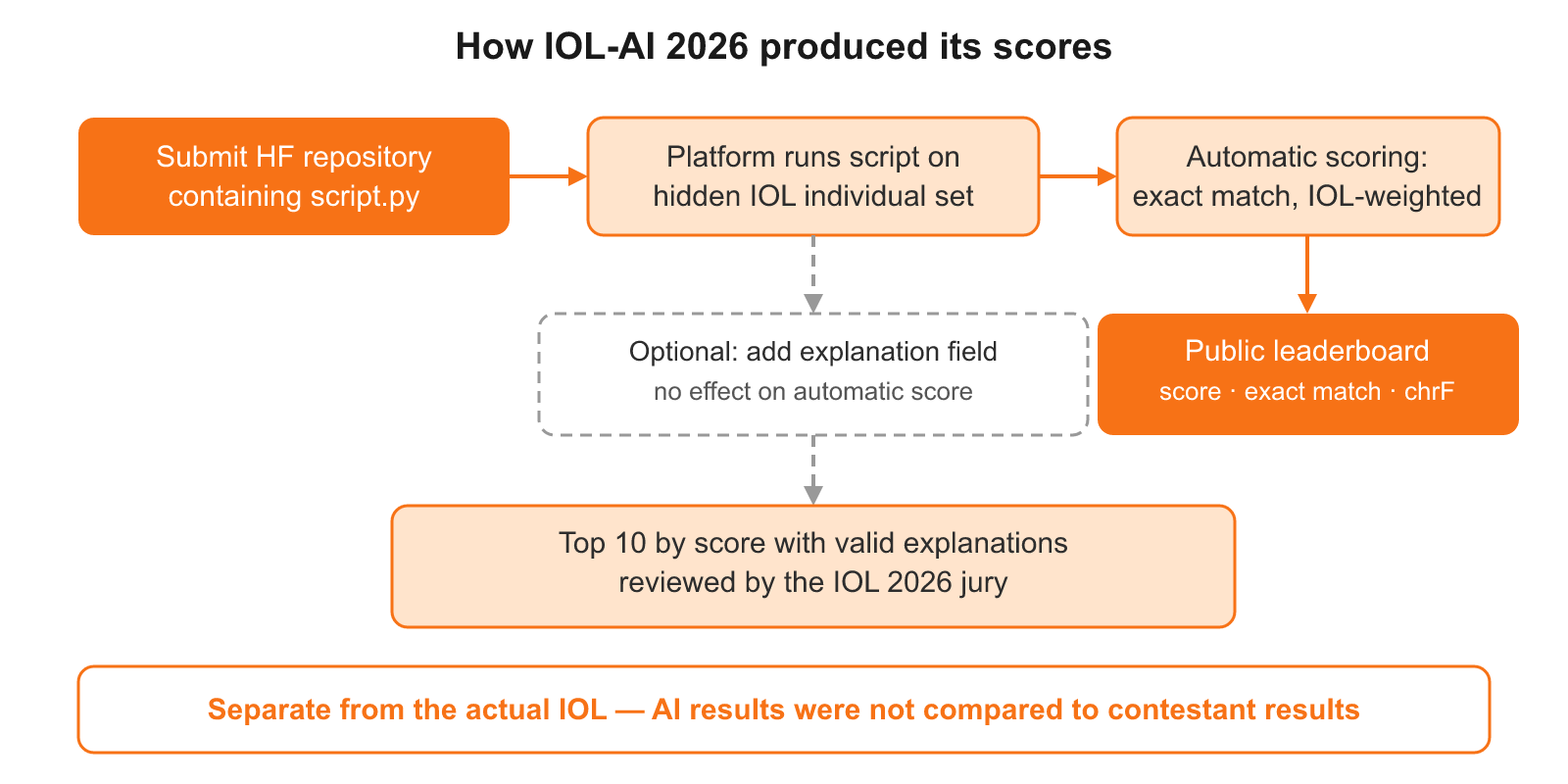
IOL-AI is not a student event and not a division of the olympiad. It is a reasoning benchmark built on olympiad material. The mechanics, as published on the official IOL-AI site, are worth understanding precisely because they determine what the scores mean:
- Same problems, same point values. Entries were scored on problems drawn from the IOL individual contest, with the official IOL point weighting applied so that harder, heavier items counted for more.
- Automated execution on a hidden set. Each team submitted a Hugging Face repository containing a
script.py. The platform ran that script against a hidden test set; teams could not see or tune for the private items. - Three metrics, all on a 0–1 scale. The headline score, plus exact match and chrF (a string-similarity measure that gives partial credit for near-correct outputs).
- Open by design. In the organisers’ own framing: public entries, open method, public leaderboard.
- Secured problem handling. The problem set was managed only by members of the IOL Jury through Hugging Face, so that AI researchers could submit before problems became public and expert review could happen on site.
The organising team combined NLP researchers with linguistics-olympiad insiders — including the Chair of the IOL Jury and a member of the IOL Problem Committee. That mix matters for reading the results: the benchmark was constructed by people who knew exactly what the human contest demanded.
The Comparison the Organisers Explicitly Did Not Make
The official site carries a statement that rules out the gold-medal framing entirely:
The AI challenge is separate from the actual IOL: the LLM solutions will not be directly compared to contestants’ solutions, and will not be part of the actual IOL event.
Three consequences follow, and they are the ones to keep straight if you see IOL-AI results quoted elsewhere:
| Claim | Status |
|---|---|
| An AI system scored above the IOL gold-medal threshold | Not measured. No contestant score distribution was published alongside the AI results, and the organisers state the two were not directly compared. |
| Leaderboard entries identify which commercial model was used | Not published. The table lists team names, not model identities. A few baseline entries are labelled by model (for example a Qwen2.5 variant), but the winning entries are not attributed to any named commercial system. |
| “Honorable mention” on the AI leaderboard equals an IOL honorable mention | Different thing. On the AI leaderboard, tiers (Tier 1 / Tier 2 / Tier 3) and honorable mentions were derived from the corrected AI scores using the benchmark’s own tier rule — not from olympiad award boundaries. |
Reading the Leaderboard: What 0.198 Means
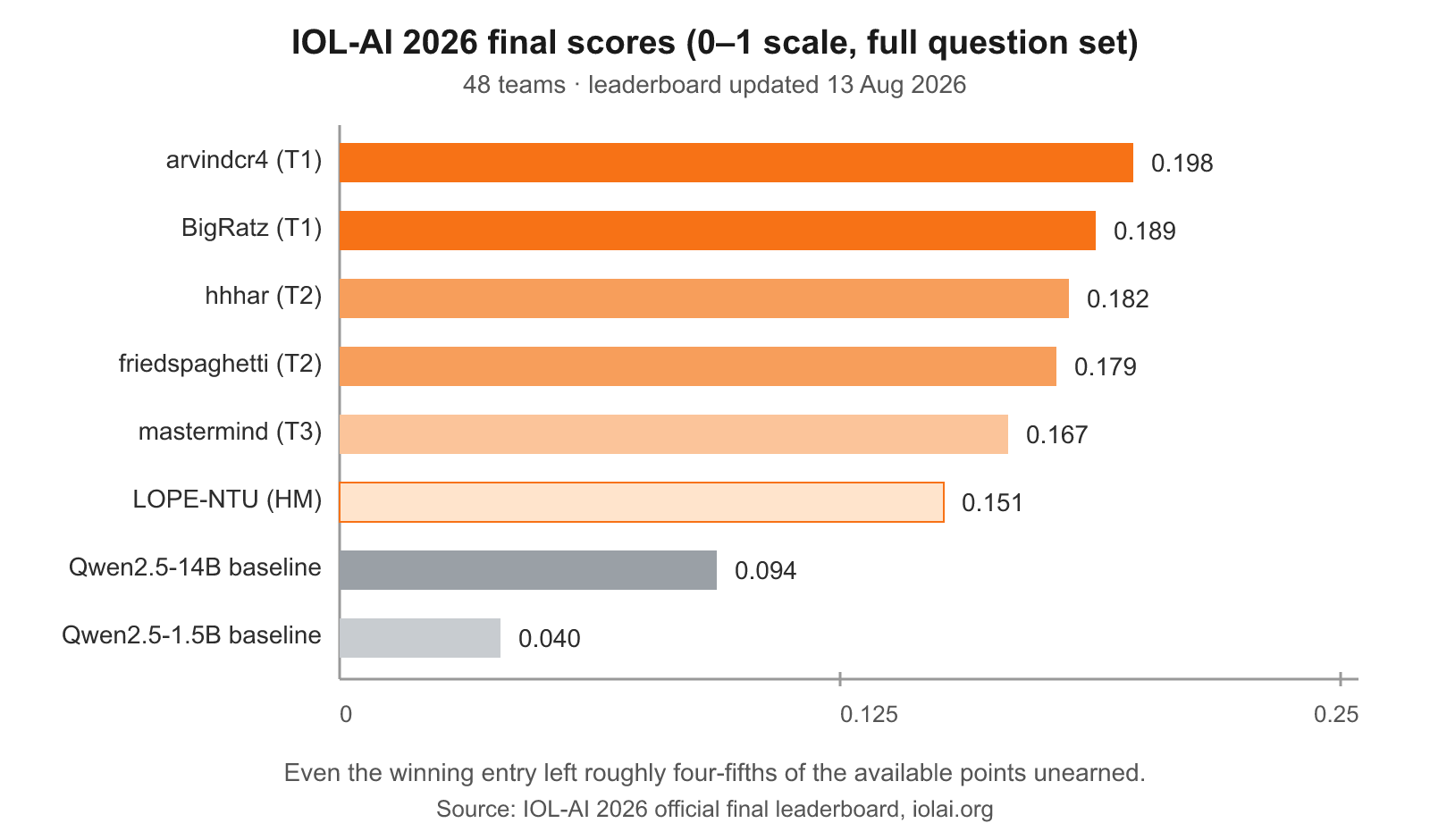
The final standings were updated on 13 August 2026 and cover 48 teams, scored on the full question set (public and hidden items together). The leading entries:
| Rank | Team | Tier | Score | Exact match | chrF |
|---|---|---|---|---|---|
| 1 | arvindcr4 | Tier 1 | 0.198 | 0.124 | 0.316 |
| 2 | BigRatz | Tier 1 | 0.189 | 0.116 | 0.307 |
| 3 | hhhar | Tier 2 | 0.182 | 0.114 | 0.291 |
| 4 | friedspaghetti | Tier 2 | 0.179 | 0.111 | 0.290 |
| 5 | mastermind | Tier 3 | 0.167 | 0.101 | 0.278 |
| 9 | LOPE-NTU | Honorable mention | 0.151 | 0.096 | 0.238 |
| 31 | Baseline-Qwen2.5-14B-AWQ | — | 0.094 | 0.045 | 0.197 |
| 41 | Baseline-Qwen2.5-1.5B-Instruct | — | 0.040 | 0.013 | 0.125 |
Several things stand out, and each of them maps onto something a human candidate experiences in the exam room.
First, the absolute level is low. A winning score of 0.198 on a 0–1 scale means roughly four-fifths of the available points went unearned by the best of 48 entrants, many of whom were professional NLP researchers. Exact match — the strictest measure, where an answer is either exactly right or not — topped out at 0.124. Olympiad linguistics items are not mildly hard for machines; they are largely unsolved.
Second, the spread between best and baseline is narrow in absolute terms. The top entry (0.198) is about five times a small baseline model (0.040), which sounds decisive, but in raw points the whole field sits inside a band of roughly 0.2. This is the signature of a task where incremental engineering buys partial credit rather than breakthroughs — the same pattern you see when a student moves from “spotted one rule” to “spotted three rules and applied them consistently.”
Third, chrF runs well above exact match for everyone. The winner’s chrF (0.316) is more than double their exact-match rate (0.124). Systems were frequently close — right shape, wrong value, or right value with an inconsistent gloss — but close is not correct. If you have ever lost marks on an IOLC paper for a transcription that was almost right, this is the machine version of the same penalty.
The Design Premise Is the Lesson: You Cannot Memorise Your Way Through
The organisers describe IOL-AI as “a reasoning benchmark you can’t memorise your way through,” and the reasoning is worth quoting because it is identical to the reasoning that makes the IOLC hard for students:
Linguistics problems cannot be solved from memorised facts. Each one is built on a language the solver has almost certainly never seen, so the only way to the answer is to reason from a handful of examples. That makes it a test of reasoning rather than recall.
This is precisely why vocabulary lists and grammar summaries have limited value in olympiad preparation, and why a student who has memorised a great deal of linguistics terminology can still score poorly. The task never asks what you know about a language; it asks whether you can derive a system from data. A machine with effectively the whole of published linguistic knowledge available during training scored 0.198. That is the clearest available demonstration that recall is not the bottleneck.
If you want the human-side version of this point, IOL 2026 Problems Without Spoilers walks through what the five Bucharest problems actually demanded, and IOL Syntax Problems shows the reverse-engineering method that works when the language is unfamiliar by construction.


The Explanation Track: Where the Benchmark Looked Most Like the Real Contest
IOL-AI included an optional second track that deserves more attention than the leaderboard, because it is the part that structurally resembles what a human candidate must do.
Entrants could add an explanation field — a short, human-readable account of how the model reached its answer, explicitly not a raw reasoning trace. Doing so had no effect on the automatic score (an explanation_rate was reported separately and excluded from score), but it made an entry eligible for the Human Evaluation Challenge. From those, the top ten by score that carried a valid explanation on a majority of problems were reviewed by the IOL 2026 jury — in the organisers’ words, “on equal footing with the contestants.”
Notice what that design implies. Getting the value right was necessary but not sufficient for jury review; the answer had to be accompanied by a legible account of the analysis. That is exactly how the IOL and the IOLC mark full-solution items. A correct transcription with no stated rule earns little; a stated rule that generates every given example earns credit even where one output slips.
This is the same habit the answer-sheet guidance in Glossing, Tables and Legible Rules is built around, and the marking method in How to Mark Your Own Practice Paper trains you to apply to yourself: check whether your stated rules reproduce every example without exception, rather than checking only whether your final answers match.
A Cautionary Detail: The Results Were Re-Scored
The official page carries a correction notice. A scoring configuration error introduced on the final day caused submissions evaluated on 26 July to be graded on only part of the question set, while earlier submissions had been graded on the full set. Every submission was re-scored with the official metric over the full question set, winner tiers were re-derived from the corrected scores, and the corrected table replaced the previously published ranking.
Two practical takeaways. If you see IOL-AI 2026 numbers quoted from before 13 August 2026, they may be the superseded ranking. And more generally: a leaderboard is a measurement with an instrument, and instruments can be misconfigured. Reading the methodology note — which is what let us establish above that no human comparison was ever run — is not optional diligence, it is the whole skill.
What This Changes for Your IOLC Preparation
Very little about your study plan, and quite a lot about how you should think about the event. Concretely:
- Stop treating AI competence as a reason to discount the olympiad. The benchmark’s own numbers show these problems are far from solved by machines. An award at IOLC or the IOL still signals something scarce.
- Keep the solve-first discipline. If a system with broad training data scores 0.198 by reasoning from examples, then your practice should consist of reasoning from examples too — not of reading analyses of problems you have already seen solved. The protocol in Using AI for Linguistics Olympiad Prep is built on exactly this: attempt the problem yourself, completely, before exposing yourself to any model output.
- Weight written justification as heavily as final answers. The jury-review track rewarded legible explanation on top of correctness. So does the IOLC. Practise writing the rule, not just the translation.
- Practise near-miss recovery. The gap between chrF (0.316) and exact match (0.124) at the top of the table is the gap between “close” and “correct.” Under time pressure, the candidates who convert near-misses are the ones who re-test their rule against every given example before moving on.
- Verify claims about AI performance before repeating them. The gold-medal claim is a small case study in why. The primary source was one page away and settled it in a single sentence.
Where the Human Contest Still Stands Apart
One last point that the benchmark cannot settle, and which is worth stating plainly: the IOL and the IOLC remain human events with human award structures. The 2027 China-route pathway — IOLC regional sitting, then the national Academic Exploration Camp, then the IOL international stage — runs on contestant performance, not on anything measured here. If you are choosing your entry level for that pathway, IOLC Junior or Senior? covers the decision, and the autumn planning guide maps the runway from now to the regional sitting.
For practice material, IOL Past Problems: The Free Practice Pack explains how Hanlin’s collected problem set is organised and how to use it under timed conditions. Coverage of worked solutions varies by year, so confirm with an advisor which files are currently available before you build a plan around them.
Frequently Asked Questions
Did an AI system beat the IOL gold-medal threshold in 2026?
The IOL-AI benchmark never measured that. The official IOL-AI site states that the AI challenge is separate from the actual IOL, that LLM solutions would not be directly compared to contestants’ solutions, and that the challenge was not part of the IOL event. No contestant score distribution was published alongside the AI leaderboard, so no such comparison can be made from the published results. Claims that a model cleared a human award line are not supported by the benchmark’s own data.
What was the highest IOL-AI 2026 score?
The top entry, team arvindcr4, scored 0.198 on a 0–1 scale on the full question set, with an exact-match rate of 0.124 and a chrF of 0.316. Forty-eight teams appear in the final standings, which were updated on 13 August 2026. Entries were grouped into Tier 1, Tier 2 and Tier 3, with honorable mentions behind them.
Does the leaderboard tell me which model each team used?
No. The published table lists team names, not model identities. Some entries are explicitly labelled baselines by the organisers — for example a Qwen2.5-14B-AWQ baseline at 0.094 and a Qwen2.5-1.5B-Instruct baseline at 0.040 — but the leading entries are not attributed to any named commercial system.
Were the AI results judged by the same people who judge the IOL?
Partly, and only on an optional track. Entrants who added a short human-readable explanation to a majority of their problems became eligible for the Human Evaluation Challenge. The top ten of those by automatic score were reviewed by the IOL 2026 jury, which the organisers describe as being on equal footing with the contestants. This review did not alter the automatic leaderboard score.
Should I still use AI tools in my linguistics olympiad preparation?
That is a preparation question rather than a results question, and the benchmark speaks to it only indirectly — though the indirect lesson is strong. Because these problems are designed so that recall does not help, the risk of asking a model first is that you lose the only rep that builds the skill. Attempt the problem completely on your own before reading any model output; the solve-first protocol in our AI preparation guide sets out how to structure that.
Why were the IOL-AI 2026 results changed after the competition closed?
The organisers published a correction: a scoring configuration error introduced on the final day caused submissions evaluated on 26 July to be graded on only part of the question set, while earlier submissions had been graded on the full set. All submissions were re-scored with the official metric over the full question set, and winner tiers were re-derived from the corrected scores. The corrected table replaced the earlier published ranking. Figures quoted from before 13 August 2026 may therefore reflect the superseded standings.
Editorial note: IOL Club (en.iolc.org.cn) is an independent information site and is not affiliated with the IOL Board, the IOL-AI organising team, the IOLC organising committee, or any national olympiad body. All benchmark mechanics, leaderboard values, tier assignments, timeline dates and the correction notice cited in this article are drawn from the official IOL-AI 2026 site (iolai.org) as published, with the final leaderboard updated 13 August 2026; they are reported as organiser-stated information. Preparation recommendations reflect the teaching team’s first-party professional judgment. This article does not compare AI results to human contestant results, because the benchmark organisers state that no such comparison was made.
Keep reading.
IOLC Consonant Digraphs: Why bh, mb and ng Stay Single Units in Rongga-Style Data
In the 2026 IOLC Newcomer/Junior Division Rongga problem note, bh, mb and ng are recorded as consonants. Learn a data-first method for…
IOLC Team Average: How Each Participating Member Changes the Score
Understand how the IOLC team average is calculated from the individual scores of actual participating members, how adding or removing a member…
IOLC 2027 Level Test: Run a 3-Hour, 4-Problem Mock Before March 7
Prepare for the IOLC 2027 Level Test (March 7) by simulating the latest source-backed 2026 regional format: three hours, four independent puzzles….