
The fastest way to improve at Linguistics Olympiad problems is not to solve more of them at random — it is to recognise the grammatical phenomena that keep reappearing inside them. This toolkit covers twelve ideas, from vowel harmony to ergative alignment, that unlock a large share of hard problems. Learn to spot each one in raw data, and puzzles from languages you have never seen start looking reassuringly familiar.
Every strong solver eventually discovers the same thing: the world's languages are wildly diverse on the surface but reuse a limited set of underlying tricks. A problem set from a language in the Amazon and one from the Caucasus can turn on the very same idea — say, that the language marks its lone subject the way English marks an object. If you have a name for that idea, you spot it in minutes. If you do not, you can lose an hour rediscovering it from scratch.
This is why concept knowledge compounds. It does not replace practice — you still need the reps described in our introduction to the IOL — but it turns each practice problem into pattern recognition rather than blind trial and error. Below is a map of twelve high-yield concepts, grouped into four families, followed by short field notes and worked mini-examples. Every example is invented to illustrate the idea; real problems use genuine, richer data.
The map: twelve ideas in four families
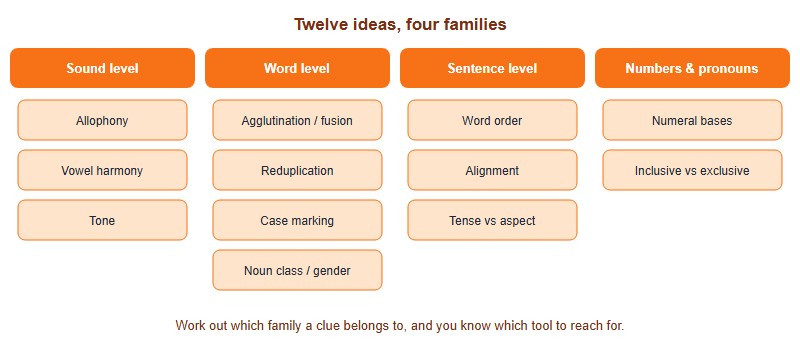
Keep the table below beside you while you drill. When a data set puzzles you, run down the “tell-tale sign” column and ask which pattern you are looking at. The archived problems in our past-problems pack are the perfect place to hunt for each one.
| Concept | What it is | Tell-tale sign in the data |
|---|---|---|
| Allophony | Two sounds are variants of one unit | A sound appears only in fixed neighbourhoods, never in a minimal pair |
| Vowel harmony | Vowels in a word share a feature | Suffix vowels change to match the root's vowels |
| Tone | Pitch distinguishes words or grammar | Same letters, different accent marks, different meaning |
| Agglutination vs fusion | Many neat suffixes, or one fused ending | Long words that segment cleanly, or a single ending doing several jobs |
| Reduplication | Repeating a word marks meaning | Plural or intensive formed by doubling part of the word |
| Case marking | Endings show a noun's role | The same noun takes different endings as subject vs object |
| Noun class / gender | Nouns fall into agreeing classes | Articles, adjectives or verbs shift depending on the noun |
| Word-order typology | The default order of S, O and V | A consistent position for subject, object and verb |
| Alignment | How subjects and objects are grouped | The lone subject is marked like the agent, or like the object |
| Tense vs aspect | Time vs completion or ongoingness | A marker tracks “finished / ongoing,” not just past / future |
| Inclusive vs exclusive | Two words for “we” | Two first-person-plural forms, one including the listener |
| Numeral bases | Counting grouped by 10, 20 or 60 | Numbers recombine at a non-ten boundary |
Sound-level ideas
Allophony is the trap where two sounds you would call different are really one sound wearing two coats. If an invented language writes k before back vowels and c before front vowels, and you never find a pair where swapping them changes meaning, they are one unit in complementary distribution. The move: before treating two symbols as separate, check whether they ever contrast.
Vowel harmony shows up when suffixes seem to have twins. Suppose a plural is -lar after a, o but -ler after e, i. That is not two random suffixes; it is one suffix whose vowel copies a feature (here, front vs back) of the root. Spot the split and you can predict forms you were never given.
Tone is easy to miss because it hides in diacritics. If bà, ba and bá mean three different things, pitch is doing lexical work. Always scan for accent marks and treat them as data, not typography.


Word-level ideas
Agglutination vs fusion tells you how to segment. An agglutinating language stacks tidy, separable pieces (house-s-in-my), so long words break apart cleanly. A fusional language crams several meanings into one ending, so a single suffix might signal person, number and tense together. Diagnose which you are dealing with early — it decides your whole segmentation strategy.
Reduplication is meaning-by-repetition. If tapu means “hill” and tapu-tapu means “hills” or “lots of hills,” doubling is a grammatical device. Watch for partial reduplication too, where only the first syllable repeats.
Case marking and noun class are the workhorses of morphology problems. In a case system, one noun wears different endings for its role in the sentence; in a noun-class system, the noun's category forces agreement on the words around it. Both reward building a neat table of who-agrees-with-what.
Sentence-level ideas (and the classic alignment trap)
Word-order typology is your first read on any sentence set: find the default position of subject (S), object (O) and verb (V). But the subtler, higher-scoring idea is alignment — how a language treats its lone subject. Consider three roles: A (the agent of a transitive verb), O (its object), and S (the single argument of an intransitive verb). English-style systems mark A and S alike and single out O. Many other languages do the opposite, marking S and O alike and singling out A. Mixing these up is one of the most common ways strong students lose points.
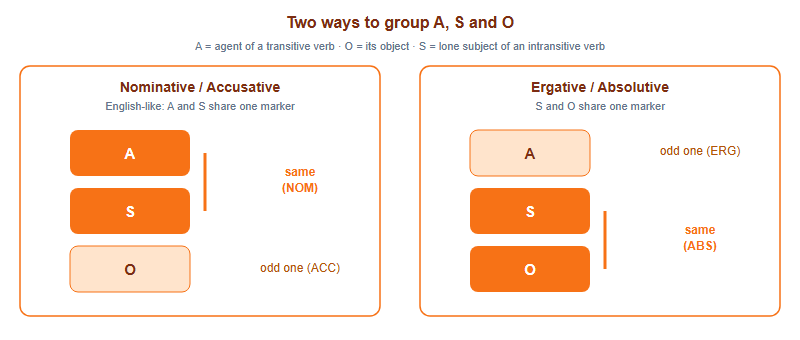
Tense vs aspect is another sentence-level distinction worth internalising. Tense locates an event in time (past, present, future); aspect describes its shape (finished, ongoing, habitual). A marker that means “the action is complete” regardless of when it happened is aspect, not tense — and translating it as a past tense will quietly break your rule. Finally, the inclusive vs exclusive distinction gives some languages two words for “we”: one that includes the listener and one that excludes them. If you see two first-person-plural forms, that is almost always what is going on. Numeral systems round out the toolkit: when counting recombines at 20 or 60 rather than 10, you are looking at a non-decimal base.
Turning the toolkit into points
Reading a list of concepts is not the same as owning them. Build ownership like this:
- Tag every problem you solve. After finishing, write which one or two concepts it turned on. Within a few weeks you will have a personal index of “which idea showed up where.”
- Keep a one-line diagnostic for each. For alignment: “What marks the lone subject?” For harmony: “Do suffix vowels shift?” Fast questions beat slow rediscovery.
- Deliberately seek your weak concepts. If tone problems scare you, hunt them down on purpose. Our 12-week study plan is built around this kind of targeted rotation rather than random grinding.
The payoff is calm. When an unfamiliar data set lands, you no longer stare at it hoping for inspiration. You run the toolkit — sound, word, sentence, numbers — and one of the twelve ideas usually raises its hand. That is how the reasoning stays honest: you are not memorising answers, you are recognising structure.
Quick answers
Do I need to memorise linguistic jargon to compete?
No. You need to recognise the patterns; the labels are just convenient handles. Every idea here is provable from the data itself.
Which concept trips up the most students?
Alignment. Assuming a language marks subjects the English way, when it actually groups the lone subject with the object, causes a lot of lost points.
Are the examples real olympiad data?
No. They are original, simplified illustrations. For genuine problems and official solutions, see ioling.org and our past-problems pack.
How many concepts appear in one problem?
Often two or three interacting at once, which is what makes hard problems hard. Naming each one separately keeps them untangled.
This is an independent guide operated by Hanlin Education for China-based international-school students. It is not affiliated with, endorsed by, or sponsored by the IOL Board. Competition details change from year to year, so always confirm current facts on ioling.org. Spotted an error? We correct verified mistakes within 7 working days.
Keep reading.
From Three Hours to Six: What Actually Changes Between a National Round Paper and an IOL Paper
A national open round gives you roughly 25 minutes a problem; the IOL gives you over an hour. Four things that change…
How to Mark Your Own Linguistics Olympiad Practice Paper When There Is No Solution Sheet
Worked solutions do not exist for every past paper. A five-band self-marking rubric, the regeneration test, and the four ways students quietly…
The Deadline Before the Deadline: Planning a 2026-27 Linguistics Olympiad Autumn Backwards From the Sitting
Registration for the coming cycle is reported to close earlier than usual. An autumn planned backwards from the sitting, with compression options…