
Most students who lose marks at a linguistics olympiad did not fail to see the pattern. They saw it, and then lost the marks somewhere between seeing it and submitting it. That gap has a small number of recurring causes — eight, in our experience marking club scripts — and each one has a different fix. Guessing which one is yours wastes months.
“I solved it” and “I scored it” are two different events
The individual contest is five problems in six hours, and contestants receive the problems in a language of their choice and write their solutions in that same language. That last detail matters more than students expect: what a marker sees is not the pattern in your head, it is the paper. Two students can reach an identical insight and walk away with very different scores because only one of them got that insight onto the page in a form that could be credited.
Exactly how credit is apportioned is set by the organisers — the Problem Committee and jury for the international contest, and your own national body for the national round — and it is not something you should assume from another competition. Confirm the marking scheme with your national organiser. What is stable across every scheme we have seen is simpler and blunter: an answer nobody can follow cannot be given the benefit of the doubt.
The eight failure modes
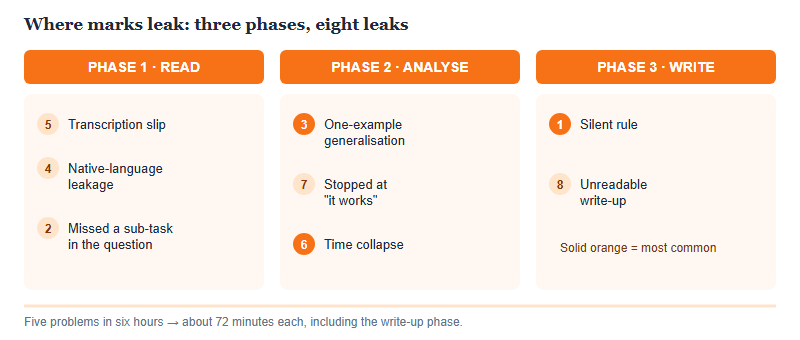
These are ordered by where they occur in a six-hour paper, not by how bad they are. In marking club scripts, modes 1, 3 and 6 account for the clear majority of avoidable losses.
| # | Failure mode | What it looks like on the paper | Why it costs |
|---|---|---|---|
| 1 | Silent rule | Correct translations, no statement of the rule you used. | The reasoning is the part that generalises. Unstated, it cannot be credited or checked. |
| 2 | Answered a different question | Beautiful analysis of part (a); parts (b) and (c) blank or half-done. | Later parts are often where the marks concentrate. Finishing beats polishing. |
| 3 | One-example generalisation | A rule inferred from a single form, then applied confidently to eight others. | If the datum was the irregular one, everything downstream inverts. |
| 4 | Native-language leakage | Assuming word order, tense or number works as in Chinese or English. | The data may contradict it, and the contradiction is usually the point of the problem. |
| 5 | Transcription slip | A diacritic dropped, two similar forms swapped, a column misaligned. | Pure, unforced loss. Costs the same as not knowing the answer. |
| 6 | Time collapse | One problem consumes two and a half hours; a solvable problem is never opened. | Five problems in six hours is roughly 72 minutes each. Overrun is borrowed, not free. |
| 7 | Stopped at “it works” | A rule that fits the data, without checking whether a competing rule also fits. | Ambiguity is often engineered in. The intended answer is the one that survives the alternatives. |
| 8 | Unreadable write-up | Arrows, crossings-out, three attempts on the page, no final answer marked. | Markers should not have to guess which line is your answer. Some will not. |
The same answer, two scores: a worked micro-example
The following toy data is invented for this article — it is not from any real problem set, and no real language is involved. Suppose you are given a fictional language and these forms:
- naru = river · naruk = my river · narum = your river
- tila = house · tilak = my house · tilam = your house
- oso = boat · osok = my boat
Asked to translate “your boat”, both students write osom. Identical answer. Now compare what else is on the page.
| Student A | Student B | |
|---|---|---|
| Answer given | osom | osom |
| Rule stated | None | “Possession is marked by a suffix on the noun: -k = 1st person, -m = 2nd person. The noun stem is unchanged.” |
| Evidence cited | None | “Confirmed across two stems (naru-, tila-) for both suffixes.” |
| Alternative tested | None | “Not a prefix system, and not stem alternation — the stems are identical in all six attested forms.” |
| If the intended answer were different | Zero. Nothing to credit. | The reasoning is still visible and internally consistent. |
Student B took perhaps ninety extra seconds. That ninety seconds is the difference between a fragile answer and a robust one, and on a real problem set — where your rule will sometimes be almost right — it is the whole game. This is also why working through past problems with their published solutions is only useful if you compare your reasoning against theirs, not just your final answers.


The second-marker method: how to find your own failure mode
Students are terrible at marking their own scripts immediately after writing them, because they read what they meant rather than what they wrote. The fix is procedural, not motivational.
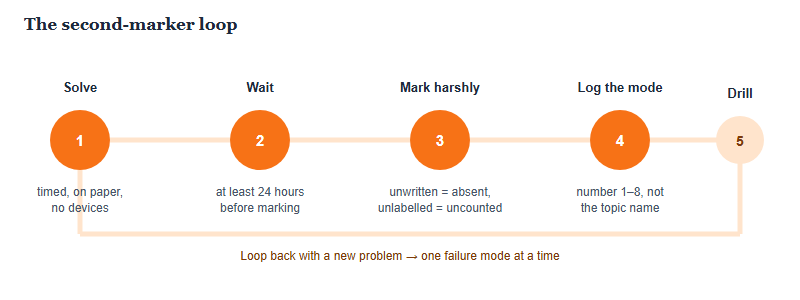
- Solve cold, on paper, timed. No dictionary, no phone, no calculator — the contest rules prohibit calculators, calendars and any device with web access, so practising with them builds the wrong habit.
- Wait at least a day. This is the step everyone skips and the one that makes the method work. You need to have forgotten your own intentions.
- Mark it as a hostile stranger. Rule: if a sentence is not written down, it does not exist. If your answer is not clearly labelled as final, it does not count.
- Log the failure mode number, not the topic. “Mode 3, over-generalised from tilak” is actionable. “Bad at morphology” is not.
- Drill the mode, then re-attempt a different problem. One mode at a time.
Two modes that get confused with each other
Modes 3 and 7 look identical from the outside — both end with a rule that turns out to be wrong — but they need opposite fixes, and misdiagnosing them is why students plateau.
Mode 3 is an evidence problem. You built a rule on too little data. The fix is discipline about counting: no rule gets written down until you can point at two independent examples supporting it, and you write that count in the margin.
Mode 7 is a competition problem. You had plenty of evidence, your rule genuinely fits all of it, and it is still not the intended analysis — because a second rule also fits, and the problem was built to distinguish them. The fix is not more examples. It is deliberately constructing the rival hypothesis and hunting for the one datum that kills it.
The tell that separates them, when you re-read your script a day later: if your rule fails on data already printed in the problem, that is mode 3. If your rule survives every printed datum but the published solution takes a different route, that is mode 7. Log them differently. Students who record both as “got the rule wrong” learn nothing from either.
Which drill fixes which mode
| If your log keeps saying… | Do this, for two weeks |
|---|---|
| Mode 1 — silent rule | Write the rule before the answers. One sentence per rule, in your contest language. |
| Mode 2 — missed a sub-task | Number every sub-question on scrap paper first; tick them off. Answer the cheapest part of every sub-question before polishing any. |
| Mode 3 — over-generalised | Ban any rule supported by fewer than two independent examples. Write the count next to the rule. |
| Mode 4 — native-language leakage | Before analysing, write one line: “things I am assuming that the data has not shown me.” |
| Mode 5 — transcription slips | Copy the data once, carefully, into a table of your own. Never work off the printed block. |
| Mode 6 — time collapse | Hard stop per problem at your target minute. Move on. Return only if time remains. |
| Mode 7 — stopped at “it works” | For every rule, write one competing rule and one reason the data rules it out. |
| Mode 8 — unreadable write-up | Final answers boxed, on their own line, in order. Working stays separate. |
If you are early in your preparation and have not yet built a routine that produces scripts worth marking, our twelve-week study plan gives the surrounding structure; this diagnostic sits inside it rather than replacing it. And if you are not yet sure what the contest actually asks of you, start with the overview of the competition first.
Frequently asked questions
Do I really lose marks for not explaining my answer?
Marking schemes are set by the organisers and vary by round. What is universal: unexplained reasoning cannot be credited or checked. Confirm your national scheme.
How long should one practice problem take?
The individual contest is five problems in six hours — about 72 minutes each including write-up. Build toward that pace rather than starting there.
Should I practise on a computer?
No. Calculators, calendars, phones and web-enabled devices are prohibited at the contest, so paper practice is the only practice that transfers.
Is it worth re-solving a problem I already got right?
Yes, if you got it right for a shaky reason. Re-solve anything where you could not state the rule cleanly a day later.
This is an independent guide operated by Hanlin Education for China-based international-school students. We are not affiliated with, endorsed by, or sponsored by the IOL Board, and this page is not an official source. The example data above is invented for illustration and is not taken from any real problem set. Contest format, rules and marking are set by the organisers and change between editions — confirm current details on ioling.org and with your national organiser. Factual errors reported to our editorial desk are corrected within 7 working days.
Keep reading.
From Three Hours to Six: What Actually Changes Between a National Round Paper and an IOL Paper
A national open round gives you roughly 25 minutes a problem; the IOL gives you over an hour. Four things that change…
How to Mark Your Own Linguistics Olympiad Practice Paper When There Is No Solution Sheet
Worked solutions do not exist for every past paper. A five-band self-marking rubric, the regeneration test, and the four ways students quietly…
The Deadline Before the Deadline: Planning a 2026-27 Linguistics Olympiad Autumn Backwards From the Sitting
Registration for the coming cycle is reported to close earlier than usual. An autumn planned backwards from the sitting, with compression options…