
Many students preparing for the International Linguistics Olympiad (IOL) or its national qualifiers like the China National Linguistics Olympiad (IOLC) fall into a specific trap: they solve problems, check answers, and move on. If they get it wrong, they feel a vague sense of inadequacy—”I’m bad at morphology” or “I ran out of time.” This intuition is often misleading. Without a structured record, you cannot distinguish between a one-off calculation error and a fundamental misunderstanding of a rule system. As we enter the preparation cycle for the 2027 IOLC season, with China-route registration deadlines approaching in late 2026, relying on volume alone is inefficient. The key to improvement is not just solving more puzzles, but diagnosing exactly where your reasoning breaks down.
The difference between a student who plateaus and one who improves lies in feedback loops. In linguistics olympiads, the feedback loop is rarely immediate because solutions are complex and often require partial credit analysis. A Linguistics Olympiad Error Log creates that loop artificially. It forces you to slow down after every mistake and ask: What did I see? What did I assume? Where did the logic fail? By answering these questions consistently, you build a database of your own cognitive biases. This article outlines how to construct such a log, how to interpret the data it generates, and how to turn those insights into a targeted two-week training plan.
Why Practice Volume Alone Does Not Fix Recurring Misses
The source material for the 2027 IOLC/NACLO season explicitly advises that after building initial practice volume, the focus must shift from simply finding the answer to understanding why a rule holds, identifying counterexamples, and considering alternative explanations. Many students miss this transition. They treat linguistics olympiads like math competitions where a single correct number suffices. However, IOL problems are deductive systems. A wrong answer usually stems from a flawed premise or an incomplete verification step, not just arithmetic slip-ups.
If you do not track these flaws, you repeat them. For instance, if you consistently fail word-order problems because you assume English-like syntax, practicing more word-order problems without logging that assumption will not help. You need to see the pattern. The source notes highlight that recurring points in phonology, morphology, and word order should be gathered and studied systematically. An error log is the tool that facilitates this gathering. It transforms scattered frustration into actionable data, allowing you to target specific weaknesses rather than vaguely “studying harder.”
Consider the psychology of practice. When you solve a problem correctly, you feel rewarded. When you solve it incorrectly, you feel punished. It is tempting to avoid the review phase because it feels like punishment. But the learning happens in the review. By creating a formal structure for review—the error log—you make the process less emotional and more analytical. You stop asking “Am I smart enough?” and start asking “Did I check the third example against my hypothesis?” This shift from identity-based anxiety to process-based checking is crucial for high-stakes competition performance.
The Five Columns of a Useable Error Log
A generic notebook entry saying “Got problem 3 wrong” is useless. To create a functional Linguistics Olympiad Error Log, you need five specific columns that capture the nature of the failure. These columns force you to articulate the gap between your solution and the correct logic. Here is a detailed breakdown of each column:
- Data Type: What kind of linguistic data was presented? (e.g., cognate sets, paradigm tables, orthographic samples, kinship terms, numerical systems). Identifying the data type helps you recognize which sub-discipline of linguistics is being tested. If you notice you frequently fail on “orthographic samples,” you know you need to practice deciphering writing systems specifically.
- Rule Stage: Where did your reasoning break? Was it during initial observation, hypothesis formation, testing against exceptions, or final application? This column isolates the step in the scientific method where you failed. Did you miss a pattern in the first place? Or did you find the pattern but apply it incorrectly to new data?
- Verification Gap: Did you check your rule against all provided examples? Did you look for counterexamples? Did you consider alternative analyses? This is the most critical column for advanced students. Often, the rule is correct, but the student fails to prove it is the *only* simple rule that fits. Logging this gap reminds you to spend time on rigorous testing.
- Time Lost: How much time did you spend on this problem compared to the average? Did rushing cause the error, or did getting stuck waste time? Time data reveals strategic errors. If you spent 40 minutes on a 10-point question and got it wrong, the issue isn’t just knowledge; it’s prioritization.
- Next Targeted Drill: What specific micro-skill needs practice? (e.g., “Practice identifying allophones,” “Review vowel harmony rules,” “Do 5 minimal pair exercises”). This column converts diagnosis into action. It prevents the common pitfall of re-reading entire textbooks when only a specific sub-topic is weak.
This structure ensures that every logged error contributes to a targeted study plan. It prevents the common pitfall of re-reading entire textbooks when only a specific sub-topic is weak. Over time, patterns emerge. You might discover that 80% of your errors occur in the “Rule Stage” for morphology problems. This tells you that your ability to observe data is fine, but your ability to generalize rules is shaky. You can then focus your reading on morphological theory rather than phonetic transcription.
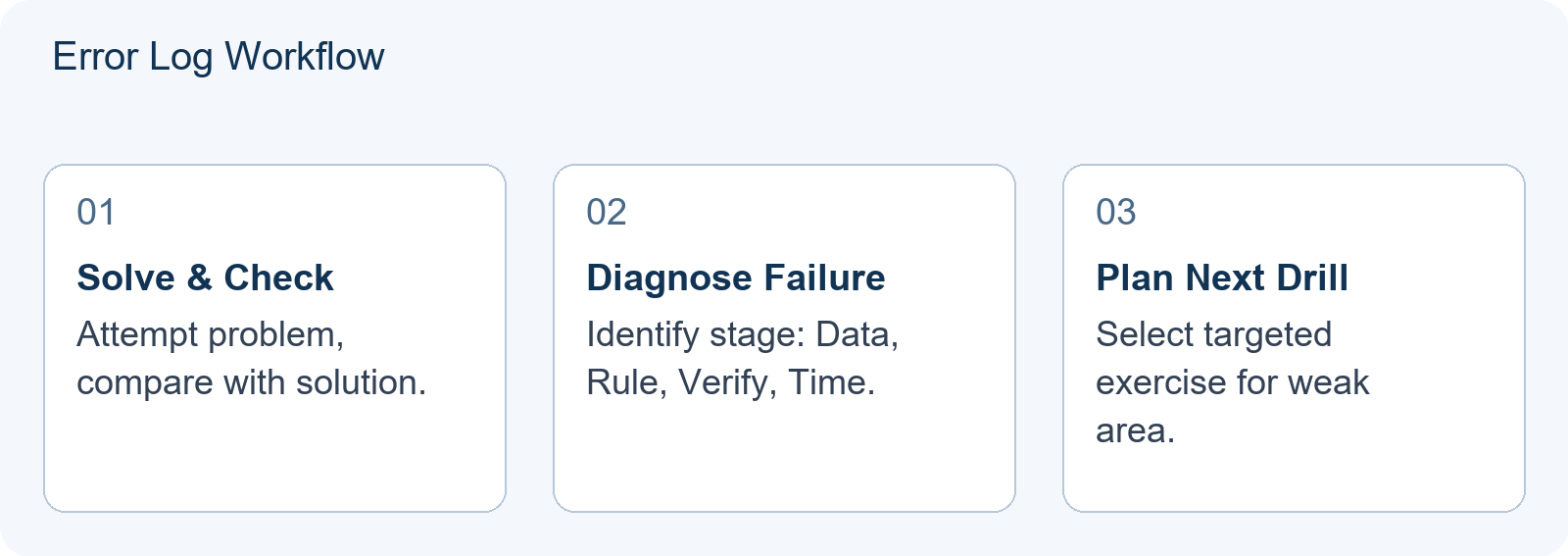
Classifying the Miss: Data Reading, Rule Formation, Verification, Time, or Output
Errors generally fall into five categories. Misclassifying them leads to ineffective remediation. Let’s define these clearly so you can label your log entries accurately.
1. Data Reading Errors
You misinterpreted the input. This includes confusing IPA symbols, missing diacritics, or misaligning translations with words. For example, treating a tone mark as stress, or assuming a hyphen indicates a compound word when it marks morpheme boundaries. These errors suggest you need to slow down and verify your transcription skills before attempting complex inference. A common cause is fatigue or lack of familiarity with the notation system. If you see many of these, revisit basic phonetics and orthography guides.
2. Rule Formation Errors
You saw the data correctly but proposed a rule that doesn’t fit. This is often due to over-generalization. You might notice a pattern in three examples and assume it applies to all, ignoring a fourth example that contradicts it. This indicates a weakness in inductive reasoning or pattern recognition. To fix this, practice looking for the “odd one out” in datasets. Ask yourself: Is there a simpler rule that explains the majority but fails here? Or is there a more complex rule that explains everything?
3. Verification Gaps
You formed a plausible rule but failed to test it rigorously. You didn’t check if the rule works for every single data point provided. Or, you didn’t consider if a simpler rule could explain the same data. This is critical in IOL problems where multiple analyses might fit, so you need to test which one is best supported by every example or is simplest. Students often rush to write the answer once they have a “good enough” guess. Logging this gap reminds you to allocate time for proof-checking.
4. Time Management Failures
You knew the answer but ran out of time to write it up properly, or you spent too long on a low-scoring part of a multi-part question. This isn’t a knowledge gap; it’s a strategic error. Logging this helps you adjust your pacing strategy for mock exams. For example, if you consistently run out of time on the last problem, you may need to set stricter time limits for the first few problems.
5. Output/Communication Errors
You solved the puzzle mentally but couldn’t express the rule clearly on paper. IOL scoring often requires explicit description of patterns. If you wrote “it changes here” instead of specifying the phonological environment, you lost marks despite being right. This highlights the need for practice in formal linguistic notation. Review articles on glossing and table formatting to ensure your written answers match the expected standard.


Labelled Teaching Illustration: Logging a Toy Morphology Miss
Note: This is a hypothetical teaching illustration, not an actual contest problem or official scoring guidance.
Imagine a student encounters a toy language with the following data:
tapa= treetapa-n= treestak= rocktak-t= rocks
The student sees tapa-n and assumes the rule is “add -n for plural.” When asked to translate “dogs” (assuming puk = dog, and puk ends in a consonant), they write puk-n. But the correct form, following the pattern of tak-t, is puk-t. They got it wrong.
Bad Log Entry: “Wrong on plural. Need to study plurals.”
Good Log Entry:
- Data Type: Paradigm table (singular/plural).
- Rule Stage: Hypothesis formation. Assumed uniform suffix -n.
- Verification Gap: Failed to check if the stem-final sound conditions the suffix. Ignored
tak-tvstapa-n. - Time Lost: 2 minutes. Rushed through first two examples.
- Next Targeted Drill: Practice identifying allomorphs based on phonological context (vowel-final vs consonant-final stems). Review articles on morphophonemics.
This detailed log reveals the issue wasn’t “plurals” broadly, but specifically “allomorphic variation conditioned by stem phonology.” The drill targets that exact skill. By comparing the good and bad entries, you can see how the structured approach saves time in the long run by preventing repeated mistakes.
Turning 20 Log Entries Into a Two-Week Drill Plan
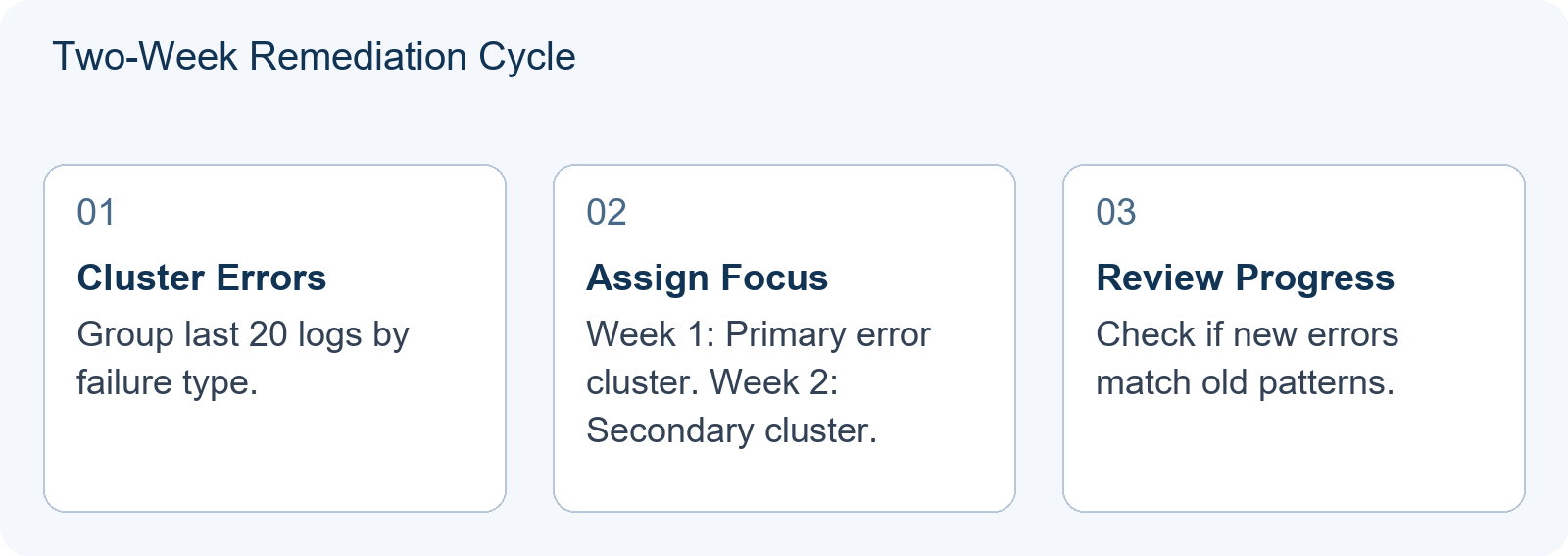
After completing several practice sets, review your last 20 error log entries. Look for clusters. Do 8 entries mention “phonology”? Do 5 entries cite “time pressure on reading comprehension”? Do 3 entries show “failure to verify counterexamples”?
Create a two-week plan based on these clusters. For example, if “verification gaps” are frequent, dedicate Week 1 to “Slow Analysis Drills.” Take one problem per day. Spend 15 minutes forming a hypothesis, then 15 minutes actively trying to disprove it using every data point. Write down why each data point supports or challenges your rule. This builds the habit of rigorous checking. You might use resources like Linguistics Olympiad Underdetermined Data: Knowing What Your Solution Has Not Proved to understand what constitutes sufficient proof.
If “data reading” errors dominate, focus on transcription accuracy. Use resources like the How to Read Linguistics Olympiad Data: IPA, Diacritics and the Pinyin Trap (2026) guide to refresh symbol recognition. Spend 10 minutes daily transcribing audio clips or unfamiliar text scripts. Consistency is key here; short, frequent drills are better than long, infrequent sessions.
If “time management” is the issue, simulate exam conditions. Set a timer for 45 minutes per problem set. Force yourself to skip a problem after 10 minutes if stuck, then return later. Log the decision process. This trains strategic skipping, which is vital for high-stakes competitions like the From Three Hours to Six: What Actually Changes Between a National Round Paper and an IOL Paper. Understanding the time constraints of different rounds helps you calibrate your speed.
If “rule formation” errors are common, particularly in morphology, review foundational concepts. Look at Linguistics Olympiad Allomorphs: When Different Word Forms Follow One Rule to clarify how surface forms relate to underlying rules. Practice breaking down words into morphemes until it becomes automatic.
When to Bring the Log to a Coach or Mentor
Self-diagnosis has limits. Once you have accumulated 10-15 well-documented entries, bring them to a mentor or coach. Instead of asking “Am I good enough?”, ask “Here are my recurring failure modes. Are these typical for my level, or am I missing a conceptual framework?”
A coach can quickly spot if your “rule formation” errors stem from a lack of exposure to certain language families (e.g., agglutinative languages) versus a logical flaw. They can also validate whether your “next targeted drills” are appropriate. For instance, if you keep failing sound-change problems, they might recommend focusing on Sound-Change and Reconstruction Problems at the Linguistics Olympiad: How to Work Backwards from Cognate Sets (2026) rather than general phonology reviews.
Remember, the goal of the error log is not to shame yourself for mistakes, but to map the terrain of your ignorance. In the 2027 IOLC season, precision in self-assessment is a significant advantage. By converting vague feelings of inadequacy into concrete, addressable tasks, you transform practice from a passive activity into an active diagnostic engine.
Furthermore, sharing your log with peers can be beneficial. You might find that others struggle with the same types of problems. Comparing logs can reveal shared blind spots, such as a tendency to ignore edge cases in numerical systems. This collaborative analysis strengthens your understanding and provides diverse perspectives on how to approach similar puzzles.
Frequently Asked Questions
Is this error log suitable for NACLO or other national rounds?
Yes, the structure applies to NACLO, IOLC and other linguistics olympiad formats, because the core skills of data analysis and rule deduction are central to these competitions.
How many problems should I solve before starting the log?
Start immediately. Even if you solve only one problem, logging the thought process establishes the habit early in the 2027 preparation cycle.
What if I don’t know the correct answer to check against?
Log the uncertainty itself. Note what you guessed and why. Later, when solutions become available, update the entry with the actual failure mode identified.
Keep reading.
IOLC Consonant Digraphs: Why bh, mb and ng Stay Single Units in Rongga-Style Data
In the 2026 IOLC Newcomer/Junior Division Rongga problem note, bh, mb and ng are recorded as consonants. Learn a data-first method for…
IOLC Team Average: How Each Participating Member Changes the Score
Understand how the IOLC team average is calculated from the individual scores of actual participating members, how adding or removing a member…
IOLC 2027 Level Test: Run a 3-Hour, 4-Problem Mock Before March 7
Prepare for the IOLC 2027 Level Test (March 7) by simulating the latest source-backed 2026 regional format: three hours, four independent puzzles….