
It is October 2026, and the 2027 IOLC/NACLO season is underway. For many students, the first hurdle in Linguistics Olympiad Problem Solving is not finding a pattern. It is trusting the first pattern too quickly. You look at a small table of forms, notice a recurring change, and immediately translate the target items. The answer may even look right. Then you discover that your rule ignored a condition, missed an exception, or applied only in a narrower environment than you assumed.
The source notes for the 2027 season point to a useful shift for advanced preparation: moving from simply finding an answer to asking why the rule holds, whether counterexamples exist, and whether another explanation fits the data. The competition is not mainly a test of language knowledge. It is a test of pattern-finding and inference from unfamiliar material. That means verification is not an optional final polish. It is part of the deduction itself.
Why Forward-Only Solving Feels Right and Fails
Forward-only solving feels efficient because it matches the direction of the question. The prompt gives you source forms and asks for target forms. You infer a rule from the source side, then apply it to the target side. If the rule is simple and exception-free, this works. But linguistics olympiad problems are usually built around conditions. A sound may change only in one position. A suffix may attach only after certain stems. A word order rule may depend on grammatical role rather than surface position.
The danger is that the first plausible rule often explains the examples you happened to notice, not the whole dataset. Suppose you see three forms where a final consonant changes. You may write a rule about final consonants. But the data might include a fourth form where a similar final consonant does not change. If you never test your rule against that fourth form, you will translate the target incorrectly and may also fail to describe the condition that protects your marks.
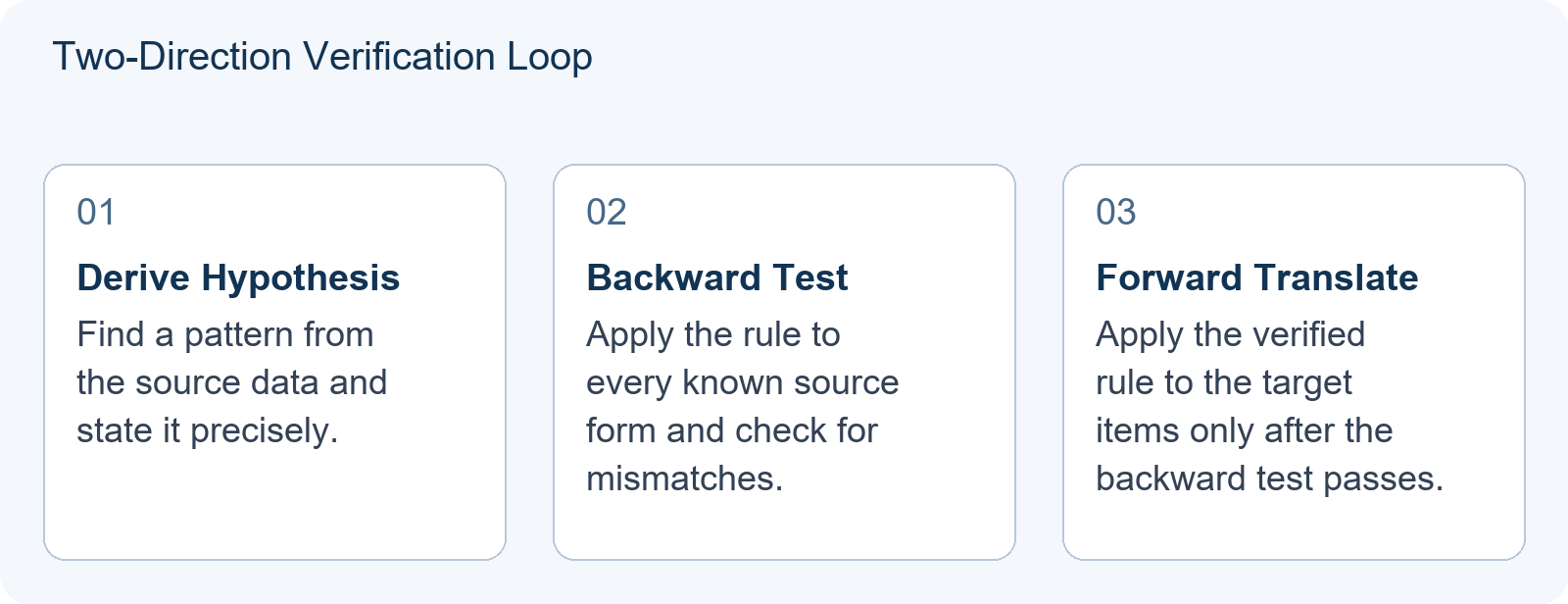
A useful habit is to treat every hypothesis as a claim that must survive contact with the full source list. Do not ask only, ‘Does this rule give the answer I want?’ Ask, ‘Does this rule regenerate every source form I was given?’ That second question forces you to run the rule backward.
The Two-Direction Test: Rule to Examples and Examples to Rule
The two-direction test has two halves. The first half is examples to rule. You inspect the data, compare forms, and write a tentative hypothesis. The second half is rule to examples. You take that hypothesis and apply it back to the known source forms. Every source form should be predictable from the rule. If even one form is not, the rule is incomplete or wrong.
This backward run is especially important when the rule involves a hierarchy or a condition. For example, a rule might say that a vowel becomes long before a voiced consonant. To verify it, you must find every source form with a vowel before a voiced consonant and check whether the vowel is actually long. You must also find vowels before voiceless consonants and check whether they remain short. If the data contains a counterexample, the rule must be refined. Perhaps length depends on stress rather than voicing. Perhaps the change happens only word-finally. Perhaps another segment blocks it.
Write the rule in a form that can be checked cell by cell. A rule that exists only as a vague intuition cannot be tested. The answer-sheet habits described in Glossing, Tables and Legible Rules: The Answer-Sheet Habits That Protect Your Marks (2026) matter here because a precise rule is easier to verify and easier to defend. If your rule says ‘something happens to vowels,’ you cannot run it backward. If it says ‘/a/ becomes [ɑ] before a final voiced stop,’ you can test every relevant form.
Labelled Teaching Illustration: A Toy Sound Correspondence, Not an Actual Contest Problem
Note: The following is a labelled teaching illustration, not an actual contest problem or official scoring guidance.
Imagine a fictional language called Zeta. The data pairs English words with their Zeta forms:
| English word | Zeta form |
|---|---|
| pat | pak |
| bat | bak |
| pad | pag |
| bad | bag |
| cap | cap |
| cab | cab |
A student notices that final t becomes k and final d becomes g. They hypothesize: ‘Final voiceless stops become k; final voiced stops become g.’ They then translate the target word mat as mak. The output happens to match the refined rule, but the rule has not yet been verified.
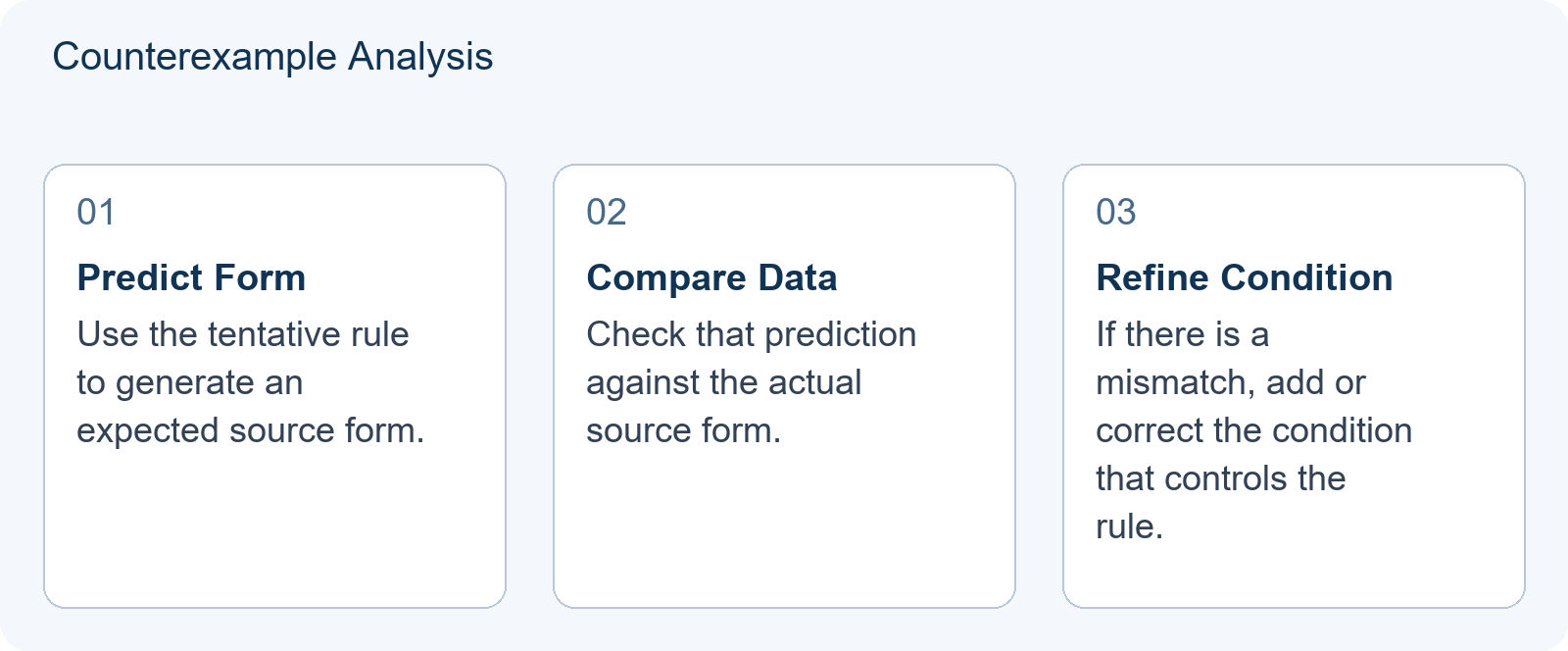
Run the hypothesis backward. Look at cap. It ends in the voiceless stop p. Under the student’s rule, cap should become cak. The data says cap. That is a contradiction. The rule is too broad.
A better rule is: final alveolar stops change, with t becoming k and d becoming g; other final stops and all non-final consonants remain unchanged. Now re-test every row. pat has final t, so it becomes pak. bat has final t, so it becomes bak. pad has final d, so it becomes pag. bad has final d, so it becomes bag. cap has final p, which is not alveolar, so it remains cap. cab has final b, which is not alveolar, so it remains cab. The refined rule fits all given data. Under it, mat becomes mak, because m is unchanged and final t becomes k. If the target were tap, the initial t is not final and the final p is not alveolar, so the Zeta form would be tap.
The lesson is not that every problem has one obvious condition. The lesson is that the backward check turns a broad guess into a testable rule. The counterexample cap forces the condition ‘alveolar’ into the rule.


The Counterexample Hunt: Turning Exceptions Into Conditions
Once you have a tentative rule, actively hunt for counterexamples. Ask what kind of form would break the rule. If the rule says that a prefix attaches before verbs, look for a verb in the data that takes a different prefix. If the rule says that number words are built in base eight, look for a number whose expression requires a carry that your base-eight rule cannot generate. If the rule says that subjects precede objects, look for a sentence where the subject is not first.
When you find a counterexample, do not discard the rule too quickly. Use the exception to add a condition. Perhaps the prefix changes before vowel-initial verbs. Perhaps the number system uses a subtractive form at one place. Perhaps the word order changes in questions or relative clauses. The exception is not an obstacle. It is the clue that makes your final rule precise.
This is where the discipline described in Linguistics Olympiad Underdetermined Data: Knowing What Your Solution Has Not Proved becomes useful. A rule that fits all given data may still be underdetermined. The backward check does not prove uniqueness. It proves that your rule is not contradicted by the source. That is the minimum standard before you translate. If two rules both survive, you need a separate decision about which is more likely or more elegant.
10-Minute Diagnostic: Did You Verify or Only Decode?
Use this quick checklist during practice sessions to audit your workflow:
- State the rule: Write your hypothesis clearly in plain English or notation. Include the environment and any conditions you have noticed.
- Apply to source: Take your rule and generate the forms for the given examples. Do they match exactly?
- Identify mismatches: If any generated form differs from the source, your rule is incomplete. Stop and revise before translating.
- Check edge cases: Look for the shortest form, the longest form, the form with the rarest sound, and the form that has the most unusual structure. Make sure the rule handles them.
- Translate target: Only after steps 1-4 pass, apply the verified rule to the new words.
If you skipped step 2 or step 3, you were decoding, not verifying. Decoding can produce correct answers when the problem is easy. Verification produces correct answers when the problem is designed to punish overgeneralization.
When to Stop Verifying and Commit Your Answer
Verification can lead to paralysis if you demand absolute certainty from ambiguous data. Sometimes two rules fit the available evidence equally well. In that situation, do not keep generating more and more speculative exceptions. Choose the simplest rule that accounts for all data. If two rules are equally simple, compare them for naturalness or for how well they explain the pattern as a whole. The article on When Two Analyses Both Fit the Data: How to Choose, Test and Hedge at a Linguistics Olympiad (2026) discusses that decision in more detail.
But do not confuse ambiguity with laziness. If a rule fails on one clear example, it is not ambiguous. It is wrong. Fix it. If it fits all examples but seems overly complex, ask whether a simpler underlying system explains the data better. If a simpler system does explain the data, use it. If only the complex rule fits, keep it and state its conditions clearly.
For the 2027 preparation cycle, the practical takeaway is simple. Before you write the final translation, pause and run your hypothesis backward. Check every source form. Hunt for the counterexample that would break your rule. Turn any exception into a condition. Then translate. That habit protects marks, but it also does something more important: it turns guessing into linguistic reasoning.
Frequently Asked Questions
Is it necessary to describe the rule in the answer sheet?
The 2026 IOL answer-sheet rules stated that, unless the problem explicitly says otherwise, competitors should describe any regularities or rules found in the material. Failure to do so may prevent full marks even if some translations are correct.
How much time should I spend verifying versus translating?
There is no fixed ratio, but verification should precede final translation. Spend enough time to ensure your rule fits all source data. Rushing to translate without backward-checking often creates errors that take longer to repair later.
What if my rule fits all examples but seems too complex?
Prefer a simpler explanation when it also fits all the data. If only the complex rule fits, keep it, but state its conditions clearly. Complexity alone is not a disqualifier if accuracy requires it.
Keep reading.
IOLC Consonant Digraphs: Why bh, mb and ng Stay Single Units in Rongga-Style Data
In the 2026 IOLC Newcomer/Junior Division Rongga problem note, bh, mb and ng are recorded as consonants. Learn a data-first method for…
IOLC Team Average: How Each Participating Member Changes the Score
Understand how the IOLC team average is calculated from the individual scores of actual participating members, how adding or removing a member…
IOLC 2027 Level Test: Run a 3-Hour, 4-Problem Mock Before March 7
Prepare for the IOLC 2027 Level Test (March 7) by simulating the latest source-backed 2026 regional format: three hours, four independent puzzles….