
What Makes Allomorph Problems Tricky in Linguistics Olympiads
In Linguistics Olympiad problems, you often see word forms that look completely different and assume they belong to different rules. The challenge of Linguistics Olympiad Allomorphs is recognizing that multiple surface forms can be realizations of one underlying pattern. This article works through two hypothetical teaching cases to show how to test that assumption—and how to recover when your first guess is wrong.
Unlike broad preparation guides, this focuses on a specific reasoning failure: treating every surface variation as evidence of a new rule, rather than asking whether the variation itself is predictable. Understanding Linguistics Olympiad Allomorphs requires this disciplined shift from surface observation to structural analysis. For students building a complete competition skill set alongside other commitments, see Linguistics Olympiad Alongside IB, A-Level or AP (2026-27): A Transfer Map for International-School Students.
Case 1: A Worked Hypothetical Where the Single-Rule Assumption Holds
Suppose you encounter a language with noun forms that show three different prefixes on what appears to be a consistent root. The forms look like this in your hypothetical data set:
- Form A: ta- + root
- Form B: da- + root
- Form C: na- + root
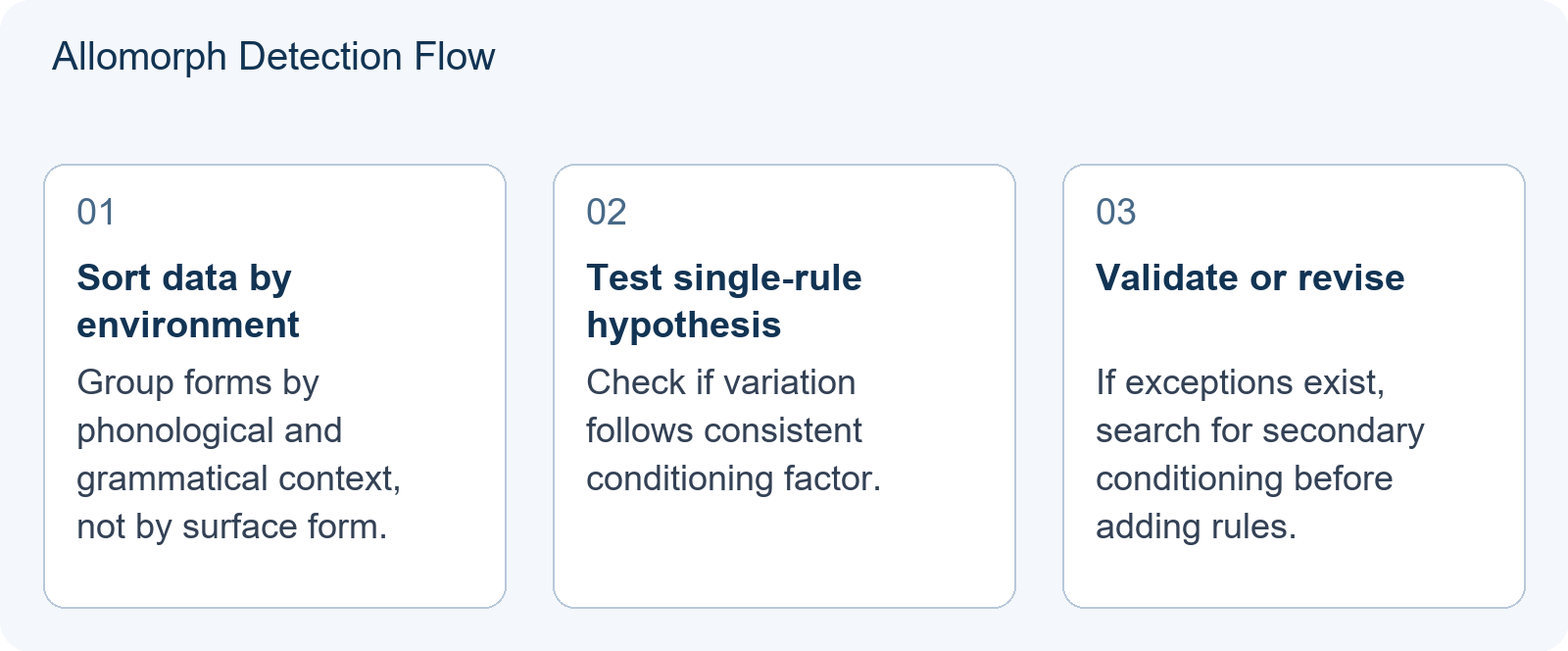
Your first task is to check whether the prefix variation is random or conditioned. Look at the first sound of the root in each case. If you discover that roots beginning with voiceless sounds take ta-, roots beginning with voiced stops take da-, and roots beginning with nasals take na-, you have found an allomorphic pattern: one underlying prefix whose surface form adjusts to the root’s initial sound.
The key diagnostic step is to sort your data by the environment of the variation, not by the variation itself. Students who list all ta- forms together and all da- forms together often miss the conditioning factor because they have grouped by the very thing they should be explaining. This is a central skill in solving Linguistics Olympiad Allomorphs problems: environmental sorting reveals hidden regularity.
This environmental sorting approach mirrors broader analytical discipline. When you need to maintain rigorous problem-solving habits while integrating new tools, the protocol in Using AI for Linguistics Olympiad Prep in 2026-27: A Solve-First Protocol That Keeps the Skill Yours offers a useful parallel: solve first, verify second, never outsource the reasoning. The same discipline applies to Linguistics Olympiad Allomorphs analysis—your own pattern detection must precede any tool-assisted verification.
Case 2: Where the Same Shortcut Fails
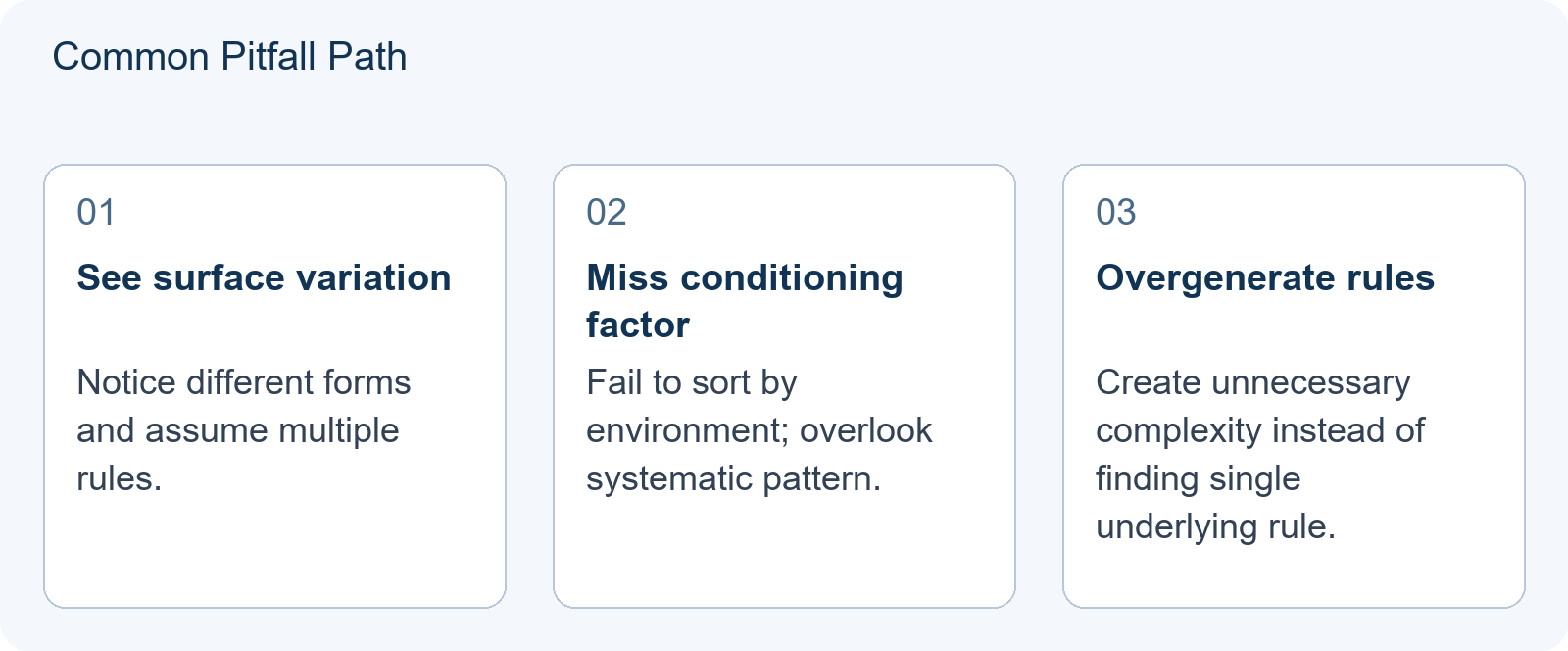
Now consider a second hypothetical language where you observe similar prefix variation, but with an added twist: some roots with the same initial sound take different prefixes unpredictably. You might be tempted to force a single-rule analysis by adding exception features or by proposing a more complex phonological environment.
Before doing so, check whether the unpredictable forms share any other property. In this hypothetical case, imagine you discover that the exceptions all belong to a specific semantic class—perhaps body parts, or perhaps loanwords. The variation is no longer purely phonologically conditioned, but the conditioning is still systematic once you identify the correct domain.
This is where many solvers get stuck: they assume that because allomorphy is typically phonological, it must always be phonological. The discipline required in Linguistics Olympiad Allomorphs problems is to let the data guide the level of analysis, not to impose a favorite mechanism. When you face genuine uncertainty about which analysis the data supports, the hedging strategies in When Two Analyses Both Fit the Data: How to Choose, Test and Hedge at a Linguistics Olympiad (2026) provide essential guidance for competition conditions.


Diagnostic Table: Single Rule vs. Multiple Rules
| Observation | Single-Rule (Allomorphic) Analysis Likely | Multiple-Rule Analysis Likely |
|---|---|---|
| Variation follows consistent phonological environment | Yes | No |
| Exceptions cluster in semantic or grammatical class | Possible secondary conditioning | Yes—check for class-specific rule |
| Minimal pairs differ only in the variable element | Yes—supports allomorphy | No—suggests distinct morphemes |
| Distribution is lexically arbitrary | No | Yes—likely suppletion or separate morphemes |
A Targeted Practice Sequence for Linguistics Olympiad Allomorphs
To build reliable judgment for Linguistics Olympiad Allomorphs problems, work through this sequence:
- Sort before analyzing: Arrange forms by every possible environmental factor (preceding sound, following sound, stress, grammatical category) before committing to a rule.
- Test the null hypothesis: Explicitly ask whether two forms could be the same morpheme. Look for overlapping distribution that would falsify this.
- Check for secondary conditioning: When phonological conditioning is incomplete, search for morphological or lexical patterns in the residue.
This three-step method transforms Linguistics Olympiad Allomorphs from a source of confusion into a structured diagnostic task. The key is resisting the temptation to name a rule before the data have been exhaustively sorted.
What Competence Looks Like
After working through cases like these, you should be able to: state the conditions under which two surface forms are likely allomorphs of one underlying element; identify when a single-rule analysis has been forced beyond what the data supports; and propose a concrete test that would distinguish allomorphy from distinct morphemes in a new problem.
This skill—holding multiple analytical possibilities in tension until the data decide—is central to what distinguishes strong Linguistics Olympiad performance from mechanical pattern-matching. As noted in the 2026 IOL-AI benchmark results published September 22, 2026, even advanced AI systems struggle with unstable, multi-step rule induction in unfamiliar languages, while human competitors who maintain disciplined, step-by-step derivation consistently outperform them. The Linguistics Olympiad Allomorphs challenge exemplifies exactly this kind of deep reasoning that remains a human advantage.
Frequently Asked Questions
How do I know if two forms are allomorphs or separate morphemes?
Check whether their distribution is complementary. If Form A appears only in environments where Form B never appears, and this distribution follows a consistent pattern, they are likely allomorphs. If they appear in identical environments with unpredictable meaning differences, they are probably separate morphemes.
What should I do when phonological conditioning doesn’t explain all the data?
Before abandoning a single-rule analysis, check for secondary conditioning factors such as grammatical category, semantic class, or loanword status. Document your search explicitly so you can show whether the residue is patterned or truly arbitrary.
Why do I keep missing allomorphy in practice problems?
Most often, this happens because you group data by the varying element itself rather than by its environment. Practice sorting your data multiple ways before analyzing, and explicitly test whether surface differences could be conditioned by adjacent sounds or grammatical features.
Keep reading.
IOLC Consonant Digraphs: Why bh, mb and ng Stay Single Units in Rongga-Style Data
In the 2026 IOLC Newcomer/Junior Division Rongga problem note, bh, mb and ng are recorded as consonants. Learn a data-first method for…
IOLC Team Average: How Each Participating Member Changes the Score
Understand how the IOLC team average is calculated from the individual scores of actual participating members, how adding or removing a member…
IOLC 2027 Level Test: Run a 3-Hour, 4-Problem Mock Before March 7
Prepare for the IOLC 2027 Level Test (March 7) by simulating the latest source-backed 2026 regional format: three hours, four independent puzzles….