
For many students preparing for the International Linguistics Olympiad (IOL) or its national qualifiers like IOLC and NACLO, the primary challenge is often perceived as finding a pattern that explains the given sentences. However, a more subtle and critical skill is recognizing when the provided data is insufficient to uniquely determine the underlying grammatical rule. This phenomenon, known as Linguistics Olympiad Underdetermined Data, can lead to solutions that are logically consistent with the examples but incorrect in the broader context of the language system.
This article focuses specifically on this reasoning failure. It does not repeat general preparation advice found in our IOL Team Contest Preparation: How the Four-Person Format Works and Why Most Students Ignore It Until Too Late, but instead offers a targeted diagnostic for students who consistently lose points despite their answers “making sense.” Understanding underdetermination requires shifting from a mindset of “fitting the data” to “testing the hypothesis.”
The Core Problem: Consistency vs. Uniqueness
In linguistics puzzles, you are typically presented with a set of sentences in an unknown language and asked to translate new sentences or explain the grammar. A common mistake is to propose a rule that works for all provided examples without checking if alternative rules could also work. If multiple distinct rules fit the same dataset, the data is underdetermined. The competition expects you to find the most parsimonious or typologically plausible rule, or to use implicit constraints to narrow down the possibilities.
Teaching illustration: Consider a hypothetical number system. Suppose you see:
na= 1ni= 2nini= 4ninini= 8
You might hypothesize that ni means “two” and repetition indicates multiplication: nini = 2×2 = 4, ninini = 2×2×2 = 8. But an alternative hypothesis is that na = 1, ni = 2, and the pattern continues with nu = 3, ne = 4, etc., making nini a compound meaning 2+2 rather than a multiplicative operation. Without seeing nu or another odd number greater than 1, the data cannot distinguish additive compounding from multiplicative repetition. This ambiguity is the essence of underdetermined data.
Worked Hypothetical Case 1: The Phonological Trap
Teaching illustration: You are given words in Language X:
[pata]= father[paka]= bread[bata]= mother[baka]= water
You are asked to translate “father’s bread.” A student notices that pa- appears in “father” and “bread,” while ba- appears in “mother” and “water.” They might conclude pa = male, ba = female, and -ta = person, -ka = substance. Thus “father’s bread” would be [pakata] or similar.
However, the data is underdetermined. An alternative hypothesis: pa and ba are noun class prefixes (perhaps singular/plural or two arbitrary genders), and -ta and -ka are the actual roots. If pa- were a gender marker, then pata and paka share the prefix but not necessarily a semantic feature. Without a fifth word showing pa- with a clearly female referent, or ba- with a clearly male one, we cannot determine whether pa/ba marks sex, gender class, number, or something else. The student’s translation might be coincidentally right or completely wrong.
Worked Hypothetical Case 2: The Syntactic Ambiguity
Teaching illustration: Language Y provides:


Ali-ø Bob-ø kima= Ali saw BobBob-ø Ali-ø kima= Bob saw AliAli-ø Bob-ø tika= Ali hit Bob
A student deduces strict SOV order: subject first, object second, verb final. This generates all three examples correctly. But consider: the language could be OSV (object first, subject second, verb final). For “Ali saw Bob,” OSV gives Bob-ø Ali-ø kima — but that is the form given for “Bob saw Ali.” Wait: with distinct proper names, SOV and OSV make different predictions. SOV: Ali Bob kima = Ali saw Bob. OSV: Bob Ali kima = Ali saw Bob (Bob is object, Ali is subject). But our second example is Bob Ali kima = Bob saw Ali. Under OSV, this would mean “Ali saw Bob” — contradicting the gloss.
The actual underdetermination here is between SOV and a free word order with case marking (here, zero-marked on both arguments). If both arguments are zero-marked for case, then with only these examples, we cannot determine whether the language has fixed SOV order or marks subjects and objects by position. To break the tie, we would need a sentence with pronouns (where case allomorphy often appears) or a semantically constrained verb like “devour” where the agent/patient roles are not interchangeable. Without such data, the student’s confidence in SOV is unwarranted.
Diagnostic Table: Is Your Solution Robust?
| Checklist Item | Sign of Underdetermination | Action Required |
|---|---|---|
| Rule Simplicity | Your rule has arbitrary exceptions that happen to match the data. | Look for a simpler rule that covers all cases without exceptions. |
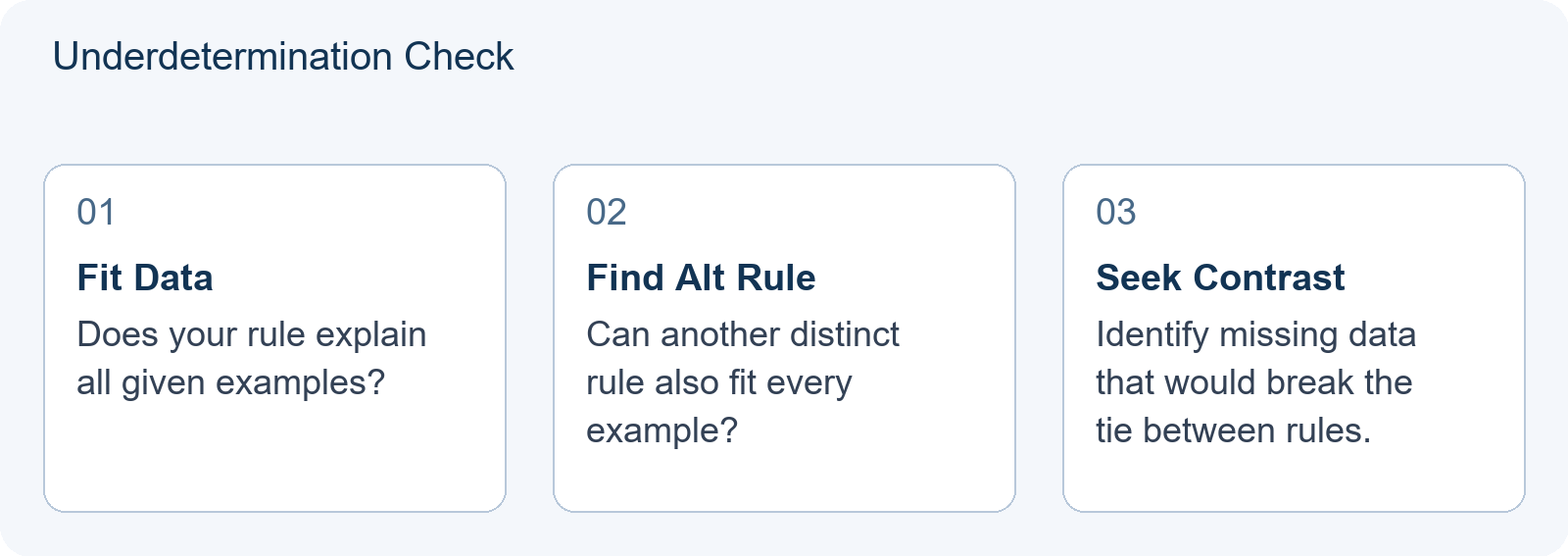
| Alternative Hypotheses | You can invent a different rule that also fits all examples. | Identify which missing data would break the alternative rule. |
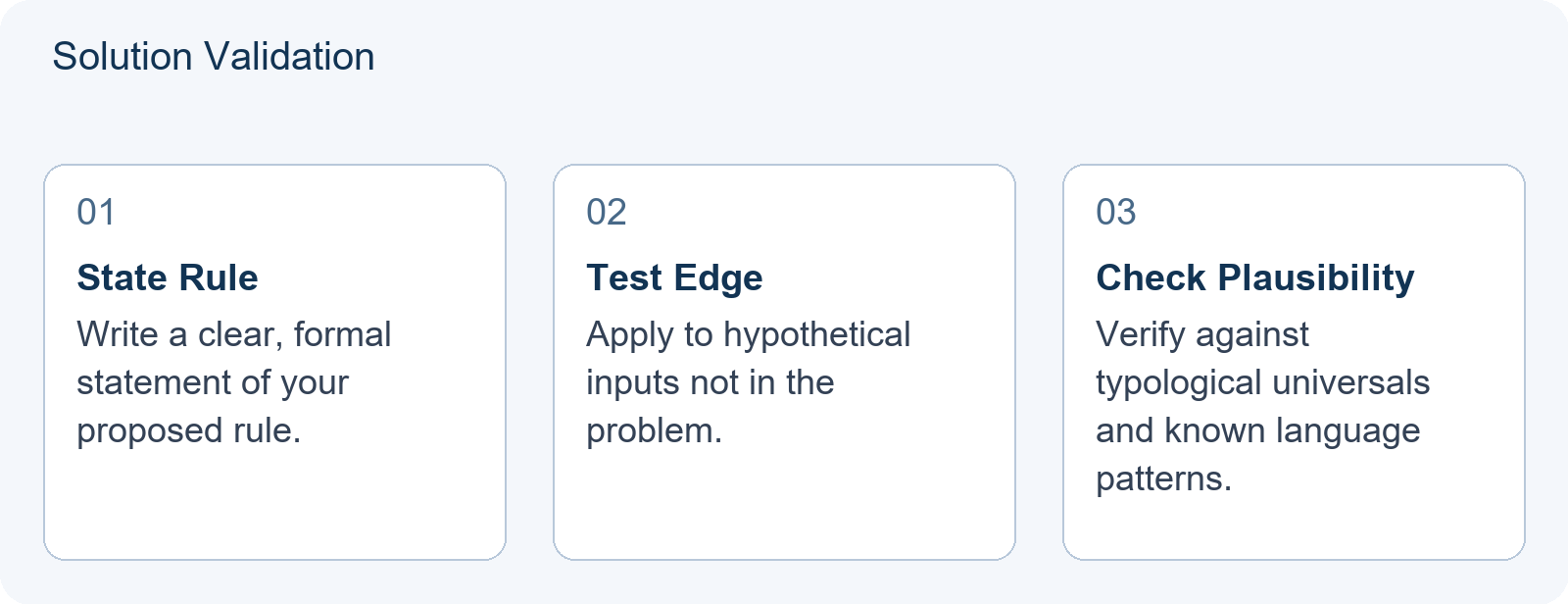
| Typological Plausibility | Your rule violates strong linguistic universals. | Re-evaluate; likely you missed a marker or misidentified a category. |
| Generalization Scope | Your rule applies only to the exact stems shown. | Test if the rule holds for hypothetical new stems. |
Targeted Practice Sequence
- Solve Past Papers: Start with official IOL problems. Note how many solutions seemed possible initially.
- Generate Counter-Examples: After solving, try to create a new sentence that fits your rule but contradicts the intended answer. This tests fragility.
- Study Typology: Read basic introductions to linguistic universals. Knowing that certain structures are rare helps you reject unlikely hypotheses. Our When Two Analyses Both Fit the Data: How to Choose, Test and Hedge at a Linguistics Olympiad (2026) extends this logic.
- Peer Review: Explain your rule to someone else. If they can spot an alternative interpretation, your data was underdetermined.
The goal in competitions like IOLC and NACLO is not just to get the right translation, but to demonstrate rigorous logical deduction. As highlighted in analysis of Best Solution, High Distinction, Merit: What Linguistics Olympiad Award Tiers Actually Reward (2026), human advantage lies in stable, complete derivation of systems, whereas AI often struggles with long-chain logic. Detecting underdetermination is a key part of this stability.
Conclusion: The Skill to Demonstrate Next
The specific skill you should aim to demonstrate is hypothesis testing via minimal contrast. When you think you have a rule, ask: “What is the smallest change in the input data that would force me to abandon this rule?” If you cannot identify such a change, your rule is likely underdetermined. Practice identifying these boundaries. This meta-cognitive approach transforms you from a pattern-matcher into a linguistic scientist, capable of navigating the ambiguities inherent in deciphering unknown languages.
Frequently Asked Questions
Why do I lose points if my answer fits the data?
You likely proposed a rule that is consistent with the visible data but fails to account for the most parsimonious or typologically standard explanation. Judges expect you to recognize when data is ambiguous and choose the best-supported hypothesis, not just any working one.
How can I tell if data is underdetermined?
Try to formulate two completely different rules that both correctly generate all the provided examples. If you can do this, the data is underdetermined. Look for missing contrasts, such as singular/plural pairs or active/passive voices, that would distinguish them.
Does Hanlin teach how to handle ambiguous data?
Yes, our IOLC preparation courses include modules on logical rigor and hypothesis testing. We guide students through past papers to identify common pitfalls where simple pattern matching fails due to underdetermined datasets.
Keep reading.
IOLC Consonant Digraphs: Why bh, mb and ng Stay Single Units in Rongga-Style Data
In the 2026 IOLC Newcomer/Junior Division Rongga problem note, bh, mb and ng are recorded as consonants. Learn a data-first method for…
IOLC Team Average: How Each Participating Member Changes the Score
Understand how the IOLC team average is calculated from the individual scores of actual participating members, how adding or removing a member…
IOLC 2027 Level Test: Run a 3-Hour, 4-Problem Mock Before March 7
Prepare for the IOLC 2027 Level Test (March 7) by simulating the latest source-backed 2026 regional format: three hours, four independent puzzles….