
Sooner or later you write two rules that both explain every row in front of you, and the paper does not tell you which one it wants. That is not a sign you have failed to see something. Small data sets often underdetermine the analysis, and the skill being tested is what you do next: run four tests, hunt for the form that separates the rivals, and if it does not exist, write a hedge that still earns marks.
Underdetermination is a property of the data, not a mistake you made
A problem gives you a finite window on a language: a dozen words, twenty sentences, one paradigm. Any finite window is compatible with more than one general rule. That is true of real fieldwork too — linguists working with hours of recorded speech routinely have competing analyses on the table — and contest setters know it. Some problems are built so that the data narrows to exactly one answer. Others deliberately leave two live, and then ask a question whose answer differs between them.
So the moment you notice the ambiguity, you are ahead of the solver who noticed nothing and picked one by instinct. What ruins scripts is not the ambiguity; it is resolving it silently. If you commit to Analysis A without saying that B existed, three things follow. You get no credit for spotting the ambiguity. If A is wrong you look as though you never understood the system. And if the question was specifically probing the difference, you have thrown away the item that the setter built the problem around.
This article assumes you already solve problems and want a procedure for this specific situation. If you are earlier in the journey, our introduction to the International Linguistics Olympiad explains the contest itself; come back to this once you are regularly finishing practice papers.
Four tests that separate rival analyses
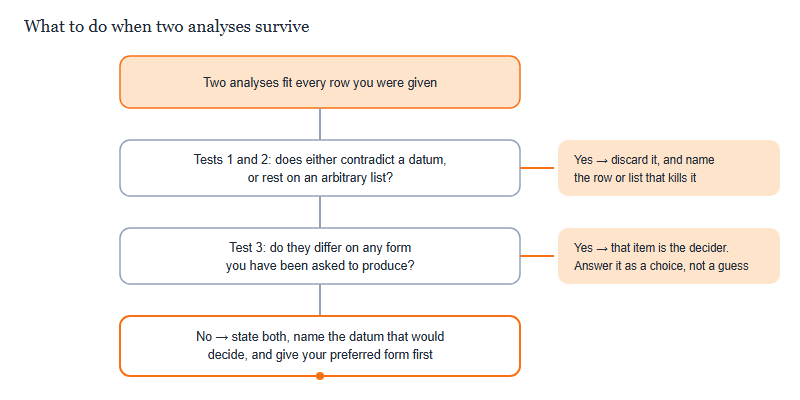
Apply them in this order, because they are cheap to expensive and decisive to suggestive.
- 1. Coverage. Does either analysis contradict a form you were given? One genuine counterexample kills a rule, unless you can state a principled exception rather than a list of awkward words. Check every row, including the ones you found easy; the killer is usually in a row you skimmed.
- 2. Economy. Which analysis needs fewer statements, fewer arbitrary lists, and fewer categories invented for the occasion? A rule that refers to a natural class (“after a nasal”) beats one that refers to a hand-written list of segments with nothing in common.
- 3. Prediction. Do the rivals actually differ on anything you have been asked to produce? If yes, the question set itself is the decider, and that item deserves your explicit attention. If they never differ on any required item, the ambiguity may cost you nothing but a sentence.
- 4. Plausibility. Does the rule resemble processes that occur in languages generally — assimilation to a neighbour, harmony across a word, weakening between vowels — or is it arbitrary? This is the weakest test and must never override coverage, but it is a legitimate tiebreaker and markers recognise it when you state the reasoning.


A worked case: which vowel controls the suffix?
Here is invented data built to show the situation cleanly. A language marks location with a suffix that appears either as -da or as -de.
| Row | Stem | Gloss | Locative form | Stem vowels | Final consonant of stem |
|---|---|---|---|---|---|
| 1 | kanu | river | kanuda | a, u | n |
| 2 | palo | field | paloda | a, o | l |
| 3 | tolu | stone | toluda | o, u | l |
| 4 | meti | wall | metide | e, i | t |
| 5 | sepe | road | sepede | e, e | p |
| 6 | keri | house | keride | e, i | r |
Three analyses survive the first reading:
- Analysis A (local agreement). The suffix vowel agrees with the last vowel of the stem: front vowel gives -de, non-front gives -da.
- Analysis B (root-controlled harmony). The suffix vowel agrees with the first vowel of the stem, with harmony spreading rightwards from there.
- Analysis C (consonant conditioning). The suffix is -de after t, p or r, and -da after n or l.
Now run the tests. Coverage eliminates nothing: all three account for all six rows. This is the moment where an inexperienced solver decides the problem is broken; in fact the problem has just started.
Economy hurts Analysis C badly. It has to write out two lists — {t, p, r} and {n, l} — which cut across every natural grouping you could name: t and p are stops but r is not, n and l are not a class to the exclusion of r. A rule stated as a list of segments with nothing in common is a description of the data, not an explanation of it. Analyses A and B each cost one statement about vowels.
Prediction finishes C off from a different direction: it makes no prediction at all for a stem ending in a consonant that appears on neither list, say one ending in k or s. An analysis that goes silent on obvious cases is under-generating, and you should say exactly that in your answer rather than merely calling it “less likely”.
Plausibility then supports A and B jointly: vowel-to-vowel agreement across a word is a widely attested kind of process, whereas a t/p/r versus n/l split conditioning a vowel is not something you can motivate. But A and B are still tied, and the reason is visible in the table: every stem in the data is internally harmonic, so “the last vowel” and “the first vowel” always give the same verdict. No row can distinguish them.
Finding the crucial datum — and what to do when it is missing
The crucial datum is the form on which your rivals disagree. Naming it is the single highest-value sentence you can write in an ambiguous problem, because it proves you understand what each analysis actually claims.
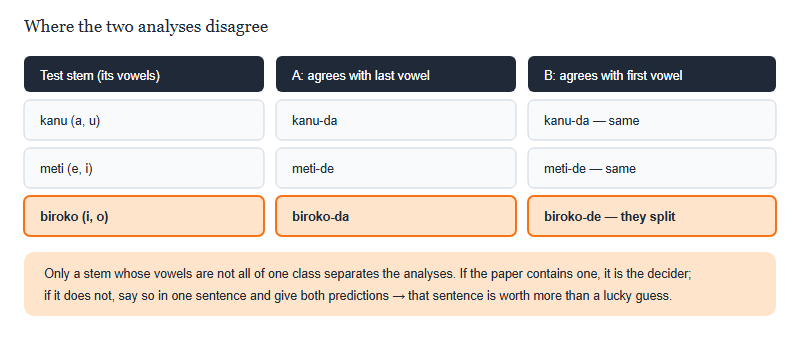
How do you look for the crucial datum efficiently? Start with the questions rather than the data. In the papers we work through, the required items usually sit on the interesting contrast, so scan the forms you have been asked to translate or produce and ask whether any of them is a mixed case. Very often one is, and the ambiguity you were fretting about is in fact the point of the problem. If none of the required items separates the rivals, you have confirmed something useful: the choice cannot cost you an answer, only the explanation, so spend one sentence on it and move on.
Writing a hedge that still earns marks
A good hedge is not vagueness. It is a decision plus its warrant plus its limits, and it fits in four sentences. The shape looks like this:
- Commit. “I take the suffix vowel to agree with the final vowel of the stem (Analysis A).”
- Warrant. “Local agreement with the adjacent vowel is the more conservative assumption here, since no form shows harmony crossing an intervening vowel.”
- Name the rival and why it survives. “Analysis B, agreement with the stem’s first vowel, fits equally well: every stem in the data is internally harmonic, so the two never diverge.”
- Name the decider. “A stem with mixed vowels — front in the first syllable, non-front in the second — would separate them: A predicts -da, B predicts -de.”
Then apply it consistently. Where a required answer differs between the analyses, give your preferred form first and the alternative in brackets, marked as such, rather than writing two answers with no indication of which you back. Ranking them lets a marker see both your answer and your reasoning; an unranked pair of forms invites the reading that you could not decide.
Know when not to hedge, too. If a rival is genuinely refuted by a row, say which row and drop it — carrying a dead analysis through your answer wastes time and dilutes the parts that are right. Do not manufacture a second analysis to look thorough. And do not hedge every item on the paper; hedging is a tool for genuine underdetermination, not a general insurance policy. In our own walkthrough sessions, the students who gain most from this technique are the ones who use it twice on a paper, precisely, rather than the ones who start qualifying everything.
Practising ambiguity on purpose
This is a trainable habit, and almost nobody trains it, because ordinary practice rewards getting to an answer. Three drills that build it:
- Argue the other side. Every time you finish a practice problem, spend five minutes writing the best rival analysis you can, even one you believe is wrong. Then write the datum that would decide between them. You will discover how often your “obvious” answer was one of two.
- Keep an ambiguity log. One line per problem: the two analyses, the deciding form, and whether the paper contained it. After a dozen entries you will start recognising the recurring shapes — local versus long-distance conditioning, suffix versus stem allomorphy, one rule ordered before another versus two independent rules.
- Swap and defend. With a club partner, take the same problem, argue for different analyses, and try to break each other’s with a constructed form. This is the fastest way to learn what counts as a real counterexample rather than an inconvenience.
For material, work from our free past-problem practice pack, and give the ambiguity drill its own slot rather than bolting it onto the end of a tiring session. If you are following a structured schedule, our 12-week study plan has review blocks that this fits into naturally: solve on the first pass, then return a few days later and attack your own solution.
The underlying shift is the one that separates a competent solver from a strong one. A competent solver asks “what is the rule?” A strong solver asks “what rules are consistent with this, and what would tell them apart?” The second question is harder, slower at first, and much more like actual linguistics — which is, in the end, what the contest is trying to reward.
Questions students ask
Do I lose marks for giving two answers?
Not if you rank them. Give your preferred form first, the alternative in brackets, and one sentence saying what would decide between them.
How do I find the deciding form quickly?
Look at the items you have been asked to produce. In the papers we work through, the required answers usually sit on the contrast that separates the analyses.
Can plausibility alone settle it?
Only as a tiebreaker. Coverage and economy come first; a natural-looking rule that contradicts a given form is still wrong.
Should I hedge on every question?
No. Use it where the data genuinely underdetermines the answer. Hedging everything costs time and reads as indecision.
IOL Club is an independent guide operated by Hanlin Education for China-based international-school students. We are not affiliated with, endorsed by, or sponsored by the IOL Board, and the data sets in this article are invented illustrations rather than past contest problems. Marking practice and paper instructions change between editions, so confirm current details on ioling.org. If you spot an error, tell us and we will correct it within 7 working days.
Keep reading.
IOLC Consonant Digraphs: Why bh, mb and ng Stay Single Units in Rongga-Style Data
In the 2026 IOLC Newcomer/Junior Division Rongga problem note, bh, mb and ng are recorded as consonants. Learn a data-first method for…
IOLC Team Average: How Each Participating Member Changes the Score
Understand how the IOLC team average is calculated from the individual scores of actual participating members, how adding or removing a member…
IOLC 2027 Level Test: Run a 3-Hour, 4-Problem Mock Before March 7
Prepare for the IOLC 2027 Level Test (March 7) by simulating the latest source-backed 2026 regional format: three hours, four independent puzzles….