
The IOL 2026 individual contest gave 255 contestants five problems worth 20 points each and six hours to solve them: Central Yup’ik, Yélî Dnye, Iquito, Sakurabiat and Komnzo. The team contest used Teotitlán del Valle Zapotec. If you have not seen the set yet, it makes an unusually good mock for 2027. This guide describes what each problem demands without giving away a single rule, then shows how to sit it.
The 2026 set at a glance
Everything in this section is visible on the first page of each problem, so reading it costs you nothing as a future mock. Each individual problem carried 20 points, for 100 in total, and all five were sat in one six-hour session. The language notes under each problem are worth reading as a set: every individual problem used a language with roughly 10,000 speakers or fewer, and three of the five used languages with a few hundred speakers or fewer.
| Problem | Language and where it is spoken | What is on the page | What you must produce | Written explanation |
|---|---|---|---|---|
| 1 | Central Yup’ik · Eskimo-Aleut · approx. 10,000 speakers, south-western Alaska | 22 spelled words with transcriptions in one dialect; four re-transcribed for a second dialect | Spell 5 transcriptions, flagging one-dialect forms; transcribe 7 spellings, both dialects where they differ | Expected by default |
| 2 | Yélî Dnye · unclassified, possibly an isolate · approx. 5,000 speakers, Rossel Island, Papua New Guinea | 27 words and phrases in three batches, translations scrambled | Match all 27; translate 7 items each way; match 6 words to pictures; explain how colours are expressed | Only the colour question |
| 3 | Iquito · Zaparoan · fewer than 100 speakers, Peruvian Amazon | 16 sentences with translations, three with two correct Iquito versions; tones omitted | 4 sentences into English, 5 into Iquito, with every possible version | Expected by default |
| 4 | Sakurabiat · Tuparian branch of Tupian · approx. 13 speakers, Brazilian Amazon near Bolivia | A family tree with four named and ten unnamed members, plus each person’s kinship phrases | Match numbers to people; order six members by birth; fill 6 blanks | Expected by default |
| 5 | Komnzo · Yam family · approx. 250 speakers, Rouku village, southern Papua New Guinea | 14 English sentences with Komnzo translations, each with a time expression | 4 sentences into Komnzo; 4 into English in all possible ways | Expected by default |
| Team | Teotitlán del Valle Zapotec · Oto-Manguean · approx. 5,000 speakers, Oaxaca Valley, Mexico | Two recorded retellings of a local legend, with tone and airflow marks and flagged loanwords; a table of verb forms | Match, complete and translate story sentences; locate emphasis; match and produce verb forms | Only where a part asks |
No two problems ask for the same kind of output, and the explanation column is not uniform, which matters more than most students expect. New to the contest itself? Start with our guide to what the International Linguistics Olympiad is, then come back.
Read the paper like a marker before you read it like a solver
The first page of the 2026 individual booklet sets a default for every problem unless the problem says otherwise: “Unless stated differently, you should describe any patterns or rules that you identified in the data. Otherwise your solution will not be awarded full marks.” Two parts of the 2026 papers do say otherwise. Problem 2 states that no additional explanation besides the answers is required, nor will be marked, and the team answer sheet carries the same line, while still asking for an explanation where a part requests one.
That changes how you spend minutes. On Problem 2, reasoning written under the matching answers earns nothing; the prose that counts is the colour question. On the other four problems, a perfect answer table with no stated rules is, by the paper’s own wording, not a full-mark solution.
Then there are the instructions tucked inside individual questions, each the kind of line a tired solver skips:
| Problem | Instruction on the paper | What skipping it costs |
|---|---|---|
| 1 · Central Yup’ik | Mark any spelling valid in only one dialect; give both transcriptions where the dialects differ | Work you had effectively done, recorded incompletely |
| 2 · Yélî Dnye | One word to translate has two meanings, and both are required | Part of that item, however good your matching |
| 3 · Iquito | Give more than one translation where possible, in English that can be understood in only one way | Alternatives you never wrote, and English a marker could read two ways |
| 4 · Sakurabiat | Each blank has only one possible answer, but an answer is not necessarily one word | A one-word guess where a phrase was needed |
| 5 · Komnzo | Translate into English in all possible ways | A single reading offered where the form allows more |
Our fix is built into every mock we run with students. Before solving anything, read all five problems and underline every instruction containing all, both, only, more than one or explain, then copy those lines onto one sheet. You check that sheet in the last fifteen minutes, when you are least able to reread a paper carefully. In the practice scripts we mark, missed instructions are consistently the cheapest marks to recover, because the analysis behind them was already done.


Five problems, five different first moves
No single opening routine works on the whole 2026 set, which is exactly what makes it good practice. Here is where we would start on each problem. This is advice about method, not about answers.
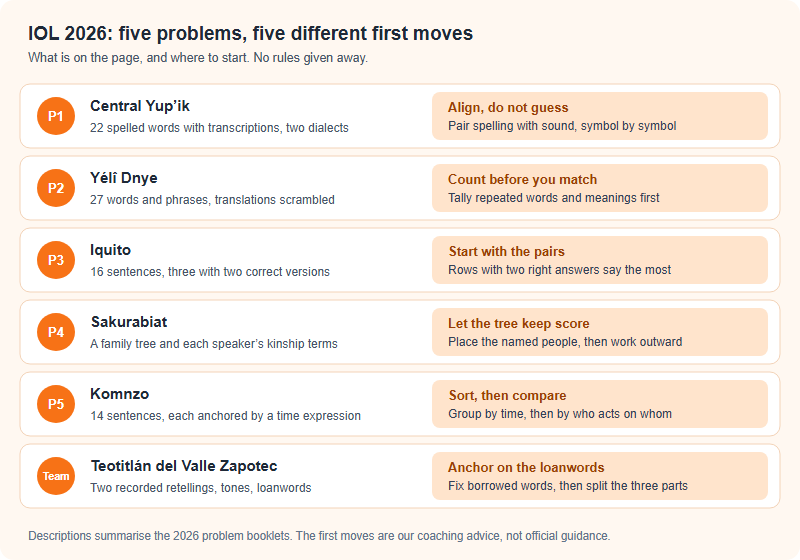
- Problem 1, Central Yup’ik: align, do not guess. You have spellings beside phonetic transcriptions, so start with bookkeeping: pair each written symbol with its counterpart in the transcription, treating syllable dots, stress marks and length marks as data rather than decoration. Only then compare the four forms given in both dialects. Read the symbol key at the foot of the problem before you align, not after.
- Problem 2, Yélî Dnye: count before you match. Twenty-seven items tempt you to guess from meanings. Instead, tally how often each word recurs across the items and how often each idea recurs across the translations; recurrences are what let you pin down the first pairs with evidence rather than intuition.
- Problem 3, Iquito: start with the pairs. Three English sentences come with two correct Iquito versions. When a setter gives more than one right answer for the same meaning, those rows carry the most information on the page, so compare them element by element first.
- Problem 4, Sakurabiat: let the tree keep score. Redraw the tree large, write in the four named people, and work first through the statements that mention them, since those have the fewest unknowns. A speaker-by-term grid beside the tree stops you rereading the same lines.
- Problem 5, Komnzo: sort, then compare. Group the fourteen sentences by time expression, then compare verbs from sentences that share a subject or an object. Part (b) asks for all possible translations, so expect some forms to allow more than one reading.
- Team problem, Teotitlán del Valle Zapotec: anchor on the loanwords. The booklet flags words borrowed from Spanish and Nahuatl and names their sources, which gives you fixed points in a long, scrambled text. Agree early who owns which of the three parts.
How to sit the 2026 set as a mock
An unseen set loses its value the moment you read a solution, a forum thread or a friend’s summary of the rules, so protect the first attempt and reproduce the real conditions. The IOL regulations are specific: a set of five problems, a duration of six hours with no break, problems handed out on paper, no artificial aids such as calculators, and phones, communication devices and anything with web access strictly prohibited.
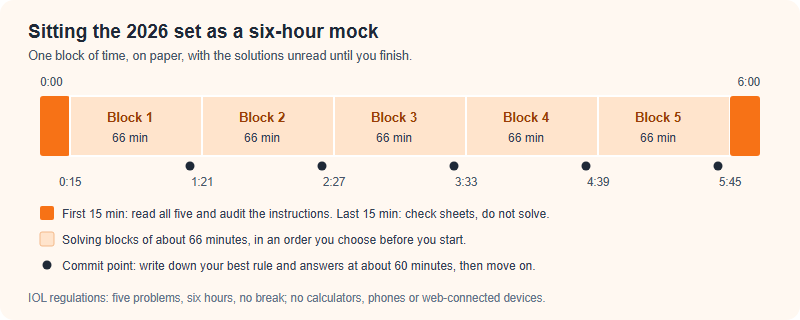
- One six-hour block, on paper. Phone in another room, and a separate numbered sheet for each problem, as the booklet instructs contestants to do.
- Fifteen minutes to read and audit. Read all five problems, build the instruction sheet, and choose your order deliberately rather than drifting into one.
- Five blocks of about 66 minutes. Around minute 60 of each block, write down your best rule and answers, even if incomplete, and move on. A committed partial solution beats a perfect analysis that never reaches the sheet.
- Fifteen minutes to check, not to solve. Work down the instruction sheet: dialect flags, both meanings, every alternative translation, every blank.
- Mark within 48 hours. Use worked solutions while you still remember your reasoning, and log four things per problem: found the system, produced the answers, stated the rules, followed every instruction.
No six-hour window? Split the set into two sittings under the same rules: three problems in about three and a half hours, then two in about two and a half. You lose the stamina element, which is real at the IOL, but keep everything else. The team problem suits a four-person club session; the regulations allow the team contest three or four hours at the discretion of the Problem Committee, so practise at three.
Our team has compiled a 2026 problem set with answers and worked solutions into our practice pack; ask which contest and which years the current pack covers. For earlier years, worked-solution coverage varies, so the exact contents follow what our teachers send you. The past-problems pack page explains how the pack is organised, and the QR code in the site footer is how to request it.
What the 2026 mix says about your 2027 practice
One year’s paper does not forecast the next, but the 2026 set illustrates three things worth building into a season.
- Breadth beats depth in a single family. Between them, the five individual problems required spelling and transcription across dialects, lexical semantics with matching, translation with alternatives, kinship reasoning and verb morphology. Drill one problem type all spring and you meet four unfamiliar openings in a single afternoon, which is why our 12-week study plan rotates through the families.
- The data is the only resource. Every individual-contest language had roughly 10,000 speakers or fewer, according to the booklet’s own notes, and Sakurabiat about 13. The IOL regulations say the competition requires no special knowledge, and a paper like this one enforces it.
- Write-ups earn a second kind of recognition. The official 2026 results list nine best-solution prizes spread across all five problems: two for Problem 1, four for Problem 4, and one each for Problems 2, 3 and 5. The regulations describe these as prizes for best solutions of individual problems, so every problem on the paper offered a route to recognition beyond the total score.
Keep one mock in proportion: it shows where you stood on one day, against one mix. Its lasting value is the log you build afterwards. After two or three full mocks the same entries tend to repeat, and those repeats, rather than the scores, should set the next month of practice.
Questions students ask
Which languages were used at IOL 2026?
Central Yup’ik, Yélî Dnye, Iquito, Sakurabiat and Komnzo in the individual contest, and Teotitlán del Valle Zapotec in the team contest.
How long is the IOL individual contest?
Six hours for five problems, with no break, under the IOL regulations. Split evenly, that is about 72 minutes per problem.
Do you have to explain your answers at the IOL?
By default, yes: the paper asks you to describe the rules you found. Some problems state that no extra explanation is required or marked.
Should I read the 2026 solutions before trying the set?
No. An unseen set is a one-time mock. Sit it timed and on paper, commit your answers, then mark against worked solutions.
IOL Club is an independent guide operated by Hanlin Education for China-based international-school students. We are not affiliated with, endorsed by, or sponsored by the IOL Board. Item counts, language notes and instructions are summarised in our own words from the 2026 problem booklets, no problem data is reproduced here, and contest formats and regulations can change between editions, so confirm current details on ioling.org. If you spot an error, tell us and we will correct it within 7 working days.
Keep reading.
IOLC Consonant Digraphs: Why bh, mb and ng Stay Single Units in Rongga-Style Data
In the 2026 IOLC Newcomer/Junior Division Rongga problem note, bh, mb and ng are recorded as consonants. Learn a data-first method for…
IOLC Team Average: How Each Participating Member Changes the Score
Understand how the IOLC team average is calculated from the individual scores of actual participating members, how adding or removing a member…
IOLC 2027 Level Test: Run a 3-Hour, 4-Problem Mock Before March 7
Prepare for the IOLC 2027 Level Test (March 7) by simulating the latest source-backed 2026 regional format: three hours, four independent puzzles….