
No IB, A-Level or AP course teaches olympiad problem-solving, but the analysis the olympiad trains shows up in specific parts of those programmes: the IB Extended Essay, TOK’s Knowledge and language theme, A-Level English Language investigations and computer science theory. Used deliberately, each feeds the other, and in an application a result backed by coursework showing the same skill is easier to believe than either on its own. Here is the map, course by course.
What the IOL itself assumes about school
The International Linguistics Olympiad is unusually candid about schools. The preamble to its regulations observes that “the sciences of language are but scantily represented in the curricula of secondary schools”. The regulations then set the entry bar: the competition “requires no special knowledge, only familiarity with such fundamental concepts from the study of language and languages as are typically present in school curricula, as well as general culture and logical thought.”
Read together, those two lines describe the position of most international-school students. Nobody expects you to have studied linguistics, but the ordinary grammar vocabulary of school language courses is assumed: subject and object, tense, plural, the gap between how a word is spelled and how it sounds. Students at China-based international schools often hold more of that vocabulary than they realise, because they frequently study more than one language formally. The regulations also list the branches problems can draw on, from phonology, morphology and syntax to historical linguistics, sociolinguistics, computational linguistics and corpus linguistics, which is why the map below reaches well beyond English lessons.
If you are still deciding whether the contest suits you at all, our overview of the International Linguistics Olympiad is the better starting point. This page assumes you are weighing how it fits around a full timetable.
The transfer map, course by course
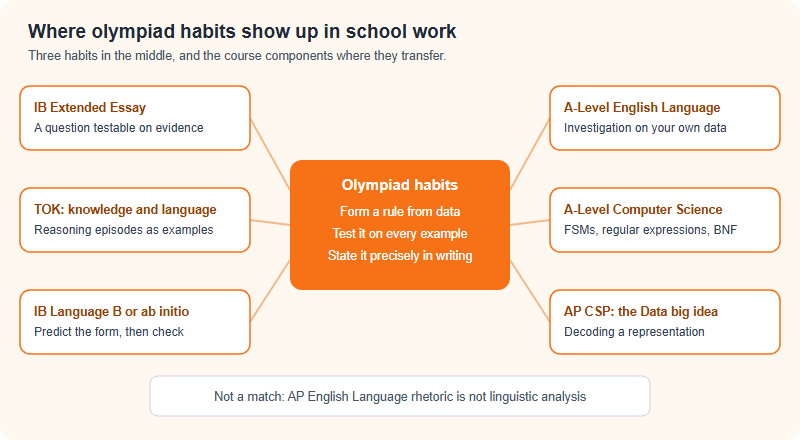
The components below are where we most often see olympiad habits pay off in coursework. None of this claims that a course prepares you for the olympiad, or the reverse. Each row names what carries across, and just as usefully, what does not.
| Programme and component | What the olympiad habit brings | What does not carry across | How to use it this year |
|---|---|---|---|
| IB Diploma: Extended Essay, up to 4,000 words, on a subject-focused or interdisciplinary pathway in the model first assessed in May 2027 | A research question narrow enough to answer from evidence, and the habit of testing a claim against every example | An EE needs sources, context and a supervisor’s agreement; a puzzle has none of these | Agree a language-related question with your supervisor and bring the data discipline, not puzzle content |
| IB Diploma: Theory of Knowledge, optional theme “Knowledge and language” | Concrete episodes where evidence forced you to revise a claim about a language | TOK assesses knowledge questions, not solutions | If your school teaches this theme, one well-described reasoning episode makes a strong example |
| IB Diploma: language acquisition, through Language B or Language ab initio | Inferring a grammar pattern from examples before being told the rule | Fluency and accuracy in producing the language are separate skills | Treat each new grammar table as data: predict the next form before checking it |
| AQA A-Level English Language (7702): the non-exam assessment “Language in Action”, a 2,000-word investigation excluding data, plus original writing and a commentary | Collecting data and describing its patterns precisely | The investigation studies English in real use, with context and attitudes; olympiad data carries neither | Frame the investigation as a pattern you can test in data you collect yourself |
| Cambridge International A Level English Language (9093): Paper 3, Language Analysis | Attention to form before interpretation | Answers concern English texts and their contexts, not unfamiliar languages | Cambridge publishes syllabuses by exam-year range, so check the one for your exam year |
| AQA A-Level Computer Science (7517): theory of computation, covering regular languages, finite state machines, regular expressions, BNF and Turing machines | Rule systems that generate or accept strings, the idea behind olympiad problems built on rule cascades and encodings | Programming and formal notation are assessed on their own terms | Notice when a problem asks for a precise, ordered rule system; the thinking is the same |
| AP Computer Science Principles: the “Data” big idea, in which bits are grouped to represent numbers, characters and colour | Decoding a representation from examples | AP CSP assesses computing concepts and programming, not linguistic analysis | A helpful frame for encoding and writing-system problems |
| AP English Language and Composition: rhetorical situation, claims and evidence, reasoning and organisation, style | Clear, ordered written reasoning | Rhetorical analysis is not linguistic analysis; the names overlap, the skills mostly do not | Do not count one as preparation for the other |
Two cautions keep the map honest. First, requirements change between exam years. The IB launched its new Extended Essay in February 2025 for first assessment in May 2027, and describes the essay as the result of roughly 40 hours of work, so older advice about EE categories may not match your guide. Second, olympiad content rarely belongs in coursework itself. An EE is not the place to re-solve a puzzle; it is the place to show the same discipline on a question your subject can own.


Cross-validation: why the pieces are stronger together
Admissions readers rarely take any single line of an application on trust. They check an award against the transcript, the activity list and the essays, and when several pieces point at the same ability, each makes the others more believable. A linguistics olympiad result shows what you did on one timed, unseen paper. Placed beside an Extended Essay or an English Language investigation built on careful analysis of language data, and a teacher who watched that work develop, it becomes evidence of a way of thinking you use all year.
| Evidence | What it shows on its own | What it corroborates |
|---|---|---|
| Olympiad award or honourable mention | Performance on an unseen, timed paper with no outside resources | That the analysis in your coursework is not a one-off |
| EE, NEA or another investigation on language data | Months of independent analysis on a question you chose | That the award reflects a skill you use outside contests |
| Teacher reference or club record | Someone observed the work over time | That the activity list describes what actually happened |
| Essay or personal statement paragraph | How you think about the work | That the reasoning you describe matches the record |
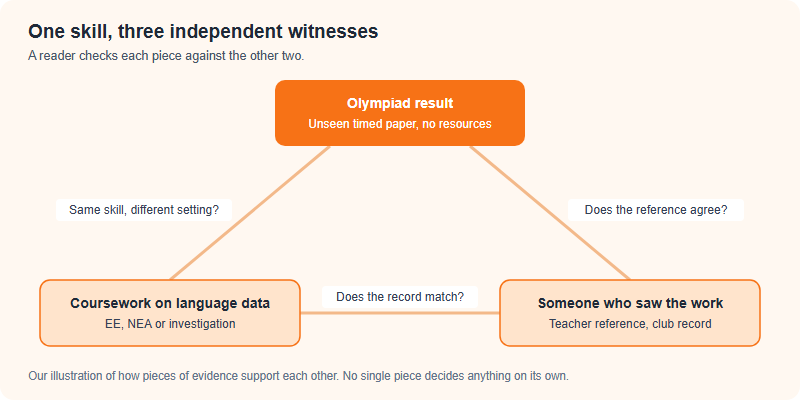
What does not corroborate: a long list of unrelated one-off competitions with no shared thread, or an essay claim that leaves no trace anywhere else in the file. None of this can promise an outcome. What it does is make an honest record easier to read correctly.
A 2026-27 calendar that respects the school year
The international event is fixed: ioling.org states that Bangkok, Thailand will host the 24th International Linguistics Olympiad from 21 to 28 July 2027. Most students at schools in mainland China reach it through the China-region route, and the dates below are the schedule our team has received for the 2026-27 cycle. The organiser’s announcements are the authority, so confirm each date before you plan around it.
| When | Milestone | Source | Question to settle with your school now |
|---|---|---|---|
| 23 November 2026 | Internal cut-off for registrations made through our team | Hanlin | Who at school approves an external entry, and how long does it take? |
| Early December 2026, exact date to confirm | China-region registration closes | Schedule received by our team; confirm with the organiser | Which EE, internal assessment, NEA or other coursework deadlines fall in late November and December? |
| 7 March 2027 | Regional written round | Schedule received by our team; confirm with the organiser | Do school mocks or internal exams fall near this date? |
| 16–18 April 2027 | National academic camp, for students who advance | Schedule received by our team; confirm with the organiser | Does it clash with spring-term assessments or travel? |
| 21–28 July 2027 | IOL 2027, Bangkok | ioling.org | Only students selected for a national team travel, but know the dates |
For most of the year, two to three hours of steady practice a week is the planning figure we give families, rising in the weeks before a paper. Put the heavier weeks around your school’s deadlines rather than on top of them. The December registration close and the March round can land beside coursework deadlines and mock exams, so draft the whole calendar in September, not in February. Use lighter school weeks to work through problems from our compiled past-problems pack.
Three mistakes we see, and the fix for each
- Treating the olympiad as a separate hobby. Students compete in March and write an EE or NEA in a different corner of their lives, so the file never shows the connection. The fix: when you choose a coursework topic, ask whether the analytical habit you are building for the olympiad has a natural home in it. If it does not, do not force it; a strained link reads worse than none.
- Assuming a similar name means similar skills. AP English Language, literature courses and olympiad problems all involve language, but rhetorical analysis and literary study are different disciplines from reconstructing a grammar. The fix: read the second and third columns of the map, not the course title.
- Planning the olympiad around the olympiad. A calendar built only from contest dates collides with school deadlines exactly when the stakes are highest. The fix: put the registration close, the March round and your school’s coursework and mock dates on one page this month, then decide where the heavier weeks go. Our 12-week study plan can start from whichever week that page leaves free.
Questions students ask
Do I need a linguistics course before trying the olympiad?
No. The IOL regulations say it needs no special knowledge, only language concepts typically present in school curricula, plus logical thought.
Can the linguistics olympiad help my Extended Essay?
It sharpens method rather than supplying content. An EE needs sources and an agreed question; bring the habit of testing claims against data.
Will olympiad practice hurt my IB or A-Level grades?
Not if you plan it. Two to three hours a week suits most of the year; schedule heavier weeks away from coursework deadlines and mocks.
How does an olympiad result help an application?
It is read alongside your transcript, activities and essays, and it carries most weight when those show the same analytical skill.
IOL Club is an independent guide operated by Hanlin Education for China-based international-school students. We are not affiliated with, endorsed by, or sponsored by the IOL Board, and we are not affiliated with the IB, AQA, Cambridge International or College Board. Course details are summarised from those organisations’ published materials and change between exam years, and the China-region dates are the schedule received by our team rather than an organiser announcement, so confirm current details on ioling.org, with the organiser and in your school’s current guides. If you spot an error, tell us and we will correct it within 7 working days.
Keep reading.
IOLC Consonant Digraphs: Why bh, mb and ng Stay Single Units in Rongga-Style Data
In the 2026 IOLC Newcomer/Junior Division Rongga problem note, bh, mb and ng are recorded as consonants. Learn a data-first method for…
IOLC Team Average: How Each Participating Member Changes the Score
Understand how the IOLC team average is calculated from the individual scores of actual participating members, how adding or removing a member…
IOLC 2027 Level Test: Run a 3-Hour, 4-Problem Mock Before March 7
Prepare for the IOLC 2027 Level Test (March 7) by simulating the latest source-backed 2026 regional format: three hours, four independent puzzles….