
The IOLC sets two entry levels—Junior and Senior—with no grade restriction, but they lead to different endpoints. According to Hanlin’s IOLC briefing for the 2027 season, only the Senior group can advance to the IOL international stage. Choosing between them is therefore less about your school year and more about your current problem-solving readiness and whether an international-stage goal is part of your plan this cycle.
Two Levels, No Grade Gate
The IOLC briefing describes the competition as suitable for students in Grades 7 through 12 who are interested in language, logic, and puzzle-solving. Crucially, the two levels—called Junior and Senior—carry no grade-based restriction. A Grade 8 student with strong analytical habits may register for Senior; a Grade 11 student encountering linguistics puzzles for the first time may legitimately start at Junior. The briefing explicitly recommends choosing based on IOLC past papers, personal linguistics foundation, and problem-solving ability rather than age or year group.
This design differs from many other olympiad pipelines where a “junior” division is simply a lower-age bracket. Here the distinction is one of difficulty and intended trajectory. If you are uncertain which national route you are eligible for in the first place, the eligibility breakdown in NACLO or the China Route? clarifies the citizenship and schooling requirements before you reach the level question.
The Advancement Rule: Only Senior Reaches Bangkok
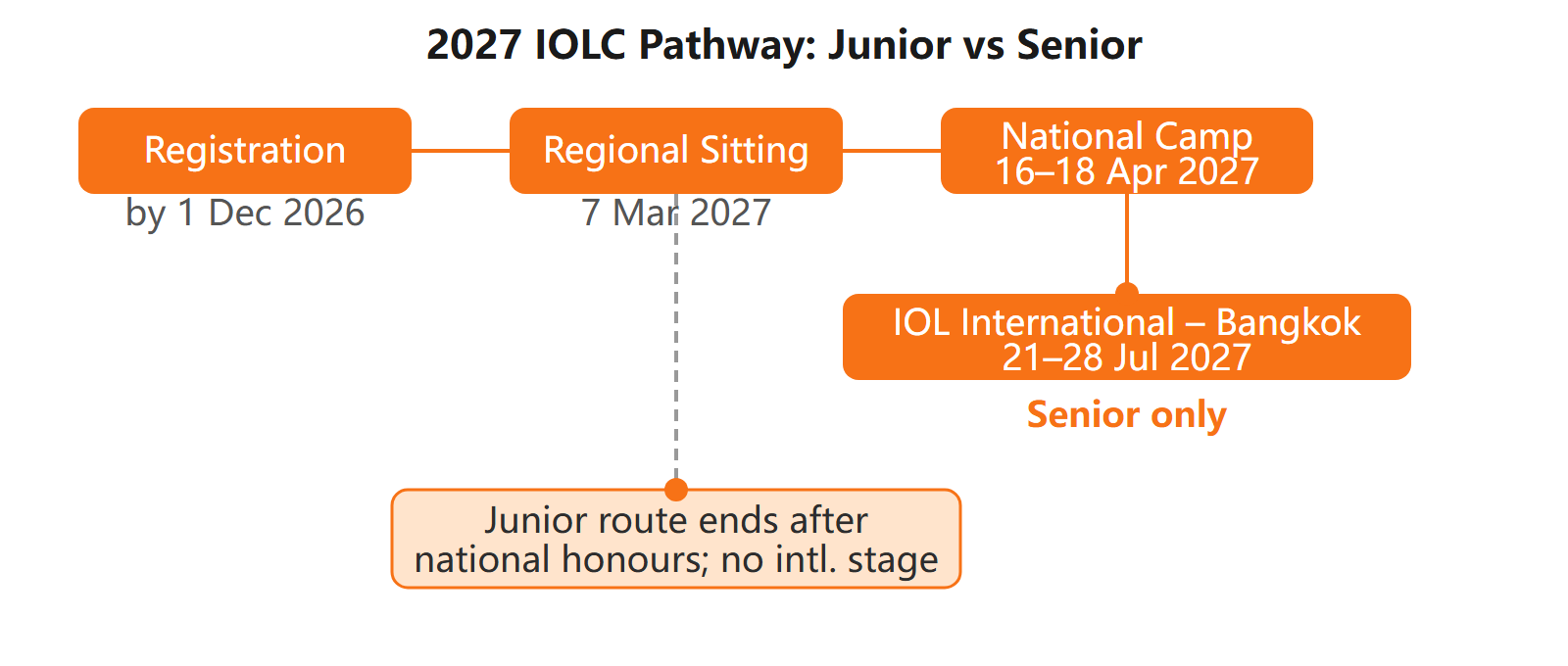
The single most consequential fact in the briefing is this: only the Senior group can advance to the IOL international stage. The 2027 international final is scheduled for 21–28 July in Bangkok, Thailand, as confirmed on the official IOL website. The China-route pathway runs IOLC Regional Sitting → IOLC Academic Exploration Camp (national round) → IOL International. Junior participants can progress through the regional and national stages, earn individual and team honours, and build competitive experience—but the pipeline to Bangkok is reserved for Senior entrants.
This does not make Junior a lesser choice. It makes Junior a different choice, one suited to students whose immediate goal is a first structured encounter with linguistics puzzles rather than an international delegation slot. The briefing frames Junior as appropriate for first-time participants with less accumulated linguistics knowledge, while Senior targets students with a stronger foundation and explicit international ambitions.
What Junior and Senior Actually Test
Both levels present the same fundamental task type: you receive data from an unfamiliar language and must deduce its rules, then apply those rules to new data. The difference lies in the complexity of the linguistic systems and the depth of written justification expected.
| Dimension | Junior | Senior |
|---|---|---|
| Intended participant | First-time or less-experienced solvers | Stronger foundation, international ambition |
| Difficulty | Lower; shorter rule chains | Higher; multi-layer, nested rules |
| Grade restriction | None specified by level | None specified by level |
| Advancement to IOL international | Not available | Available |
| Individual & team honours | Yes, by region and nationally | Yes, by region and nationally |
| Registration format | Individual or team of 2–4 | Individual or team of 2–4 |
An illustrative contrast: a Junior problem might present eight sentences in a previously unseen language and ask you to translate two new sentences, requiring you to identify one or two morphological rules. A Senior problem at the same sitting might present a larger data set with interacting phonological and syntactic constraints, asking you to state the rules explicitly and justify why alternative analyses fail. These are illustrative descriptions of the difficulty gap, not reproductions of actual items.


A Past-Paper Decision Check
The briefing recommends using IOLC past papers as the primary diagnostic. Here is a practical sequence you can follow before registration closes:
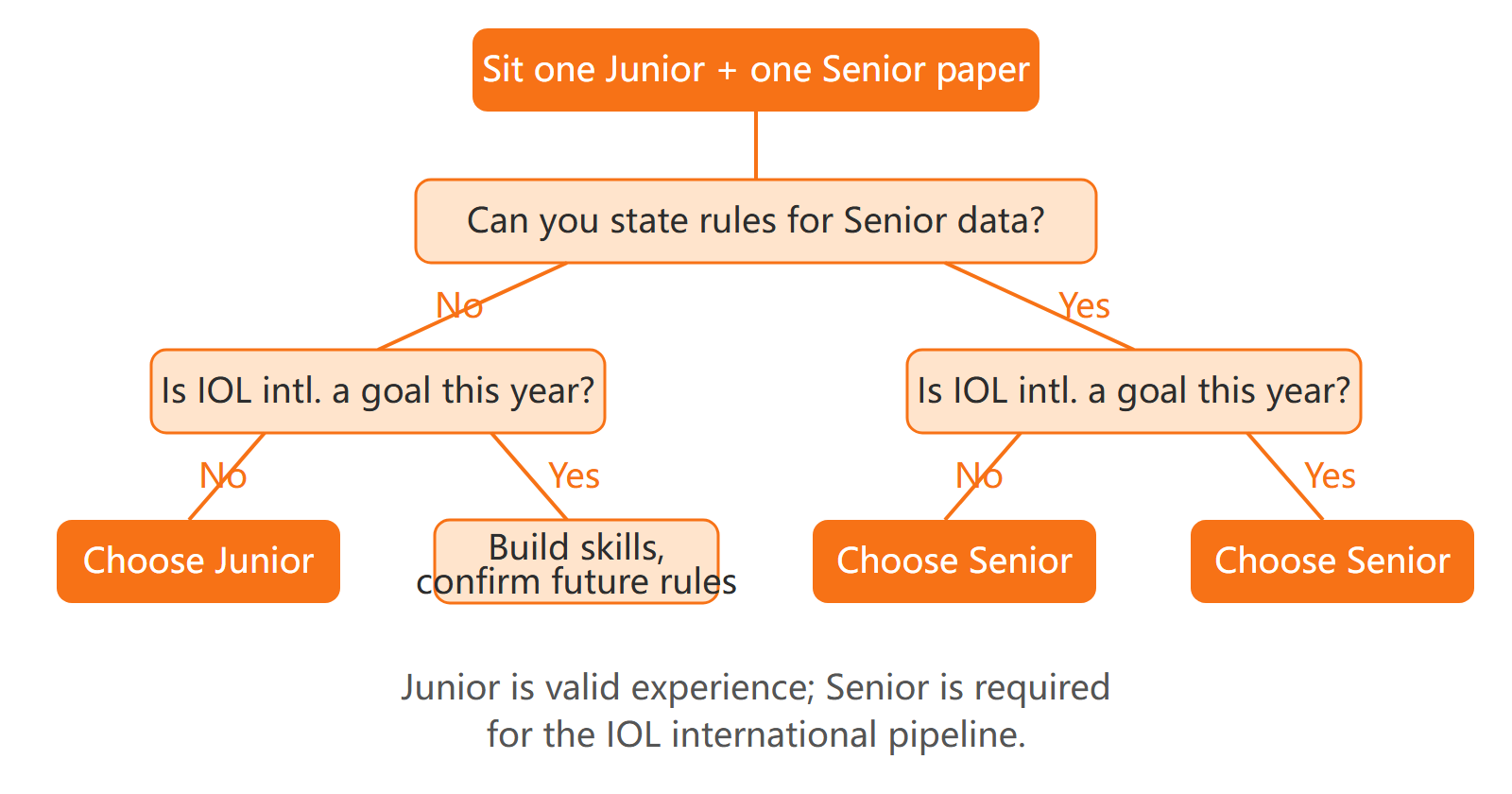
- Sit one recent Junior paper and one recent Senior paper under timed conditions. Treat them as mock sittings. If you have never seen a linguistics puzzle before, the 45-minute self-diagnostic guide offers a structured way to gauge your starting point.
- Score yourself honestly. The method in How to Mark Your Own Practice Paper applies even when no official solution sheet is available: check whether your stated rules generate every given example without exception.
- Assess the bottleneck. If you could identify the rule on the Junior paper but ran out of time writing it clearly, your issue is pacing, not comprehension. If the Senior paper left you unable to formulate any rule at all, the gap is analytical depth.
- Match to your goal. If your aim this year is simply to experience the format and build confidence, Junior is a legitimate and productive entry. If you want a realistic shot at the national-to-international pipeline, you need to be working at Senior difficulty now, even if your score is modest.
What Junior Still Offers
Choosing Junior does not mean opting out of meaningful competition. The briefing confirms that individual honours are awarded by regional ranking and team honours by national ranking at both levels. A Junior participant still receives a structured problem set, a timed environment, and feedback in the form of scores and rankings. For a Grade 7 or 8 student encountering linguistics puzzles for the first time, that structured first experience is genuinely valuable: it reveals whether the discipline suits you before you commit a full preparation cycle to Senior-level work.
Junior also preserves optionality within the current season’s structure. The 2027 briefing addresses the level as a registration-time choice for this cycle; it does not publish a rule either permitting or prohibiting a different level choice in a subsequent season. A student who sits Junior in 2027 and wishes to enter Senior in a later year should confirm that future season’s registration rules when they are released, rather than assuming the current-season choice automatically carries forward. The level is a preparation decision for the season in which you register.
Timing: The 2027 Season Window
The briefing lists the following key dates for the 2027 cycle. Registration closes on 1 December 2026, with Hanlin’s assisted-registration deadline on 23 November 2026. The regional sitting is scheduled for 7 March 2027, the national Academic Exploration Camp for 16–18 April 2027, and the IOL international stage in Bangkok for 21–28 July 2027. If you are planning backwards from the sitting date, the autumn planning guide maps the preparation runway in detail, and the IOL 2027 Bangkok overview covers what is confirmed about the international venue.
Because registration format allows teams of two to four, the briefing notes that team entry carries two additional advantages: a separate team score and team certificate, and an extra pathway to qualify for the national round. This is relevant at both Junior and Senior levels.
Avoiding the Two Most Common Mistakes
Mistake 1: Choosing by grade alone. Because there is no grade gate, a well-meaning parent or teacher might say, “You’re in Grade 9, so do Junior,” or “You’re in Grade 11, so you must do Senior.” The briefing’s own recommendation is to decide by past-paper performance and problem-solving ability. A Grade 9 student who can already parse multi-rule Senior data under time pressure gains nothing from a Junior paper; a Grade 11 student meeting linguistics puzzles for the first time will benefit more from Junior’s gentler rule chains than from being overwhelmed at Senior.
Mistake 2: Treating level choice as an outcome guarantee. Registering for Senior does not guarantee advancement to the national camp, let alone to Bangkok. Registering for Junior does not, in the 2027 briefing, state a permanent bar on future participation; however, the briefing addresses only the current season’s choice, and future-season eligibility should be confirmed when those rules are published. The level is a preparation decision that shapes what you practise and which pipeline you enter this season. Awards and advancement depend on your actual performance relative to other entrants in your region and nationally, as determined by the organisers. If you are still deciding whether linguistics is the right olympiad for you at all, Is Linguistics Actually Your Olympiad? offers an honest framework for that earlier question.
Frequently Asked Questions
Can a Grade 7 or 8 student register for the Senior level?
Yes. According to Hanlin’s IOLC briefing, both Junior and Senior levels carry no grade restriction; the briefing describes the competition as suitable for Grades 7–12. It recommends choosing based on past-paper performance, linguistics foundation, and problem-solving ability rather than school year. A younger student who can handle Senior-level rule deduction under timed conditions is not barred from entering Senior.
If I enter Junior in 2027, can I switch to Senior in a later season?
The 2027 briefing describes the level as a registration-time choice for this season’s competition and recommends selecting the level that suits your current ability. It does not publish a rule that explicitly permits or prohibits registering at a different level in a subsequent year. If you plan to enter Senior in a future season after sitting Junior now, confirm that future season’s registration rules with the organising body when they are released, rather than assuming the current-season framework automatically applies.
Does choosing Junior permanently disqualify me from the IOL international stage?
The Senior-only advancement rule applies to the season in which you register: choosing Junior in 2027 means you cannot advance to Bangkok in July 2027. The 2027 briefing does not state a permanent, cross-season bar. However, it also does not publish an explicit re-entry provision for future seasons. Whether you may register at Senior level in a later year depends on that year’s published rules. Confirm future-season eligibility with the organising body when the next cycle’s registration opens.
Editorial note: IOL Club (en.iolc.org.cn) is an independent information site and is not affiliated with the IOL Board, the IOLC organising committee, or any national olympiad body. Level descriptions, advancement rules, and season dates cited here are drawn from Hanlin’s IOLC organiser briefing and the public IOL website; they are reported as organiser-stated information and do not constitute a guarantee of eligibility, advancement, or award outcomes. Always verify current-season details with the organising body before registering.
Keep reading.
IOLC Consonant Digraphs: Why bh, mb and ng Stay Single Units in Rongga-Style Data
In the 2026 IOLC Newcomer/Junior Division Rongga problem note, bh, mb and ng are recorded as consonants. Learn a data-first method for…
IOLC Team Average: How Each Participating Member Changes the Score
Understand how the IOLC team average is calculated from the individual scores of actual participating members, how adding or removing a member…
IOLC 2027 Level Test: Run a 3-Hour, 4-Problem Mock Before March 7
Prepare for the IOLC 2027 Level Test (March 7) by simulating the latest source-backed 2026 regional format: three hours, four independent puzzles….