
When you open a linguistics olympiad syntax problem, the first thing you see is a string of unfamiliar words. Your instinct—shaped by English—screams that the first noun is the subject, the next is the verb, and what follows is the object. But in many languages featured at the International Linguistics Olympiad (IOL) and its national qualifiers, grammatical roles such as subject and object are signaled by morphology, not by where a word sits in the sentence. Learning to separate grammatical roles from sentence position is the difference between solving a problem and chasing a phantom pattern. This article gives you a reliable method, a fully checked worked illustration, a contrasting case where a common heuristic fails, and a diagnostic you can apply immediately.
The Core Distinction: Role vs. Position
In English, position is almost everything. “The dog bit the man” and “The man bit the dog” are truth-conditional opposites because English encodes subject and object by word order. In many IOL languages, however, case endings, agreement prefixes, or infixes identify who did what to whom. Within a single language, several word orders may be acceptable if morphology stays constant; conversely, swapping which noun carries which marker changes the meaning even when position stays fixed.
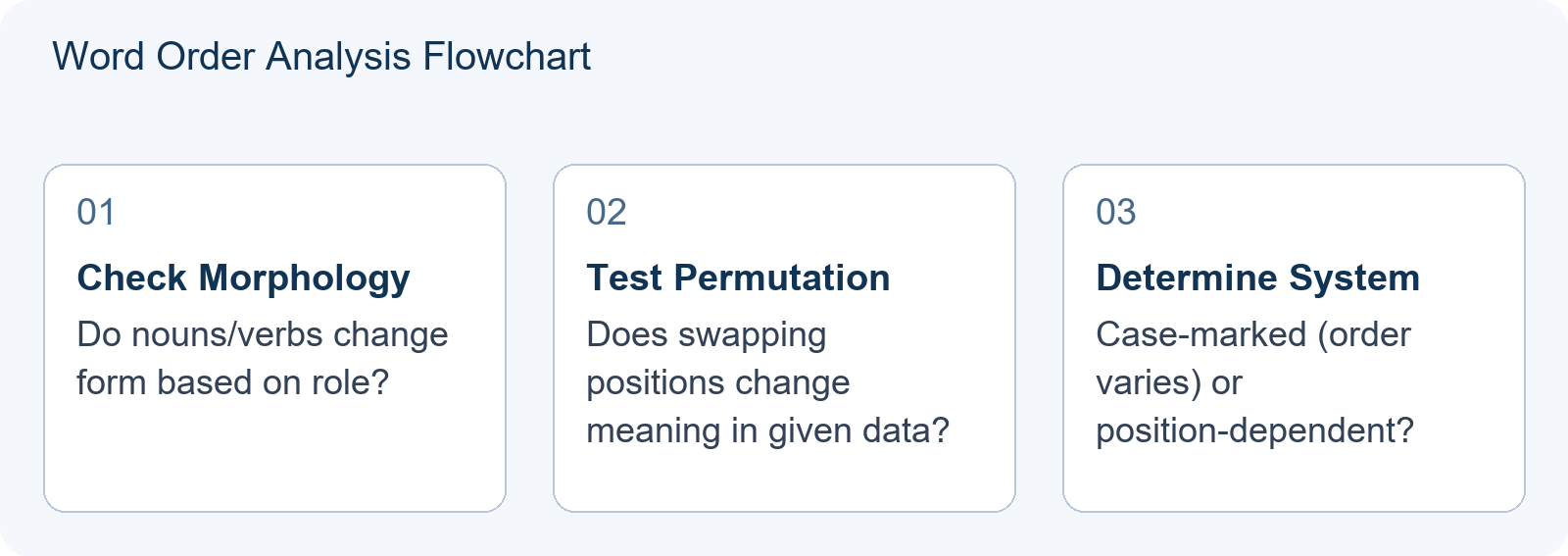
For competition purposes, this means your first move should never be to assume a fixed word order. Your first move is to look for invariant morphological elements. Does the subject carry a specific suffix regardless of where it appears? Does the object trigger a prefix on the verb? These cues are more reliable than linear position because they survive permutation. Once you have established the morphological system, you can use position secondarily—to identify information structure, emphasis, or stylistic variation—but never as your primary evidence for grammatical role.
Worked Teaching Illustration: Analyzing a Constructed Language
Note: The following example is a teaching illustration designed to demonstrate the analytical method. It is not an actual contest problem.
Consider the following data for a constructed language called Kala, with stems and suffixes explicitly defined:
taru= teacheryawi= studentnaku= sees-ka= subject marker (marks the one doing the seeing)-ma= object marker (marks the one being seen)
Given sentences:
- Sentence 1:
taru-ka yawi-ma naku= “The teacher sees the student.” - Sentence 2:
yawi-ma taru-ka naku= “The teacher sees the student.” - Sentence 3:
yawi-ka taru-ma naku= “The student sees the teacher.”
Step 1: Identify recurring stems and affixes. The stems are taru and yawi; the verb is naku. The affixes are -ka and -ma.
Step 2: Track which affix attaches to which referent in which role. In Sentence 1, taru-ka is the subject (the one who sees), and yawi-ma is the object (the one seen). In Sentence 2, the order is reversed, but taru-ka is still the subject and yawi-ma still the object—the translation stays the same. In Sentence 3, yawi-ka is the subject and taru-ma is the object, so the roles reverse.
Step 3: State the rule. The suffix -ka marks the subject (the entity doing the seeing), and -ma marks the object (the entity being seen). In these three examples, word order varies without changing the translation when the morphology stays constant; changing which stem carries which suffix changes the translation regardless of position.
Verification: Check for consistency. If -ka always marks the subject and -ma the object across all three sentences, the hypothesis holds. No counterexample appears in the data. The method succeeds because it prioritizes morphology over position.
Important caveat: In this illustration, “subject” means the syntactic subject of the clause—the argument marked by -ka that corresponds to the one doing the seeing. In natural languages, the semantic agent (the doer) does not always align with the syntactic subject; experiencers, patients, or other roles can be marked as subject depending on the language’s case system (ergative, passive, etc.). The suffix -ka here marks a grammatical relation, not necessarily a semantic role.
Contrasting Case: Where Position-First Analysis Fails
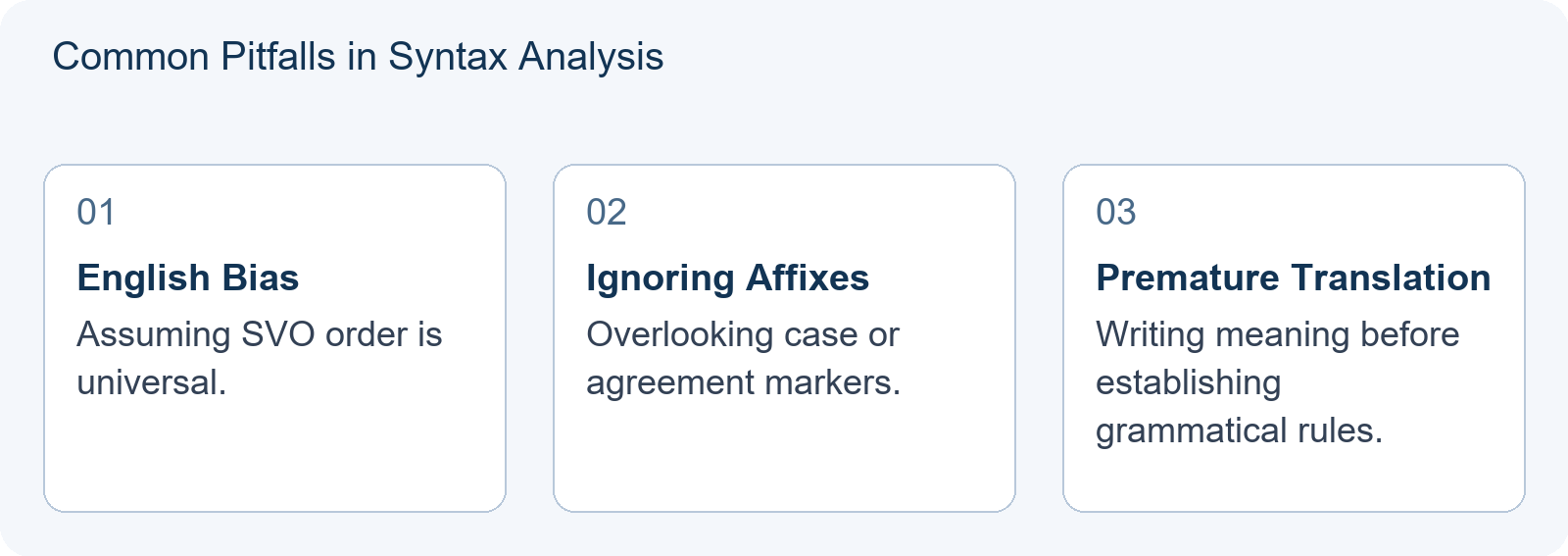
Suppose a student approaches Kala with an English bias. They see Sentence 1 and conclude: first noun = subject, second noun = object. They then encounter Sentence 2, yawi-ma taru-ka naku, and apply the same positional rule. Because yawi comes first, they translate it as “The student sees the teacher”—exactly wrong, because yawi-ma is marked as object and taru-ka as subject.
Notably, if they applied the same first-noun=subject heuristic to Sentence 3 (yawi-ka taru-ma naku), they would accidentally get the correct translation “The student sees the teacher.” This coincidence makes the error especially dangerous: one correct result can falsely validate a flawed method, while the same method fails on Sentence 2.
The failure mode is clear: positional heuristics derived from English overpredict where English-like order is absent. The correction is to suspend the positional assumption until morphological analysis is complete. Only after establishing that Kala marks roles by suffixes does the student return to position to ask secondary questions: why does the speaker choose yawi-ma taru-ka over taru-ka yawi-ma when both are grammatical? That question belongs to information structure, not to grammatical role assignment.
Diagnostic Application: The Permutation Test
Apply this three-step diagnostic to any new syntax dataset:
- Isolate and track: Identify all noun-like and verb-like elements. Note every affix that appears with each stem.
- Correlate affixes with roles: For each sentence, determine which stem is subject, which is object, which is verb. Record which affixes appear with which role.
- Check the data you have: Ask whether the provided examples show order variation while keeping the same translation. If yes, morphology is likely doing the grammatical work. If no, position may be doing that work. Do not invent additional permutations beyond what the data provides.
This test is decisive on the data you actually have. In the Kala illustration, the answer to step 3 is that two of three examples show order variation with identical translation. In a rigid SVO language with no case marking, no such variation would appear. In a language with both case marking and a default word order, you might see limited variation or marked/unmarked alternatives.


What the Diagnostic Result Means for Your Next Step
If your data shows order variation with constant morphology, your next learning task is to master the morphological inventory: case paradigms, agreement patterns, and clitic placement. Consult Linguistics Olympiad Allomorphs: When Different Word Forms Follow One Rule to understand how a single morpheme may surface as prefix, suffix, or infix depending on phonological context. Recognizing these variants prevents you from treating ka- and -ka as different markers when they are the same case in complementary distribution.
If your data shows rigid word order, your next task is to identify the positional constraints precisely: is it SVO, SOV, VSO, or something more exotic? Then ask what other syntactic phenomena correlate with that order—prepositions versus postpositions, relative clause position, and question formation. These patterns cluster typologically and appear frequently in IOL problems.
For students deciding between entry levels, this skill has direct implications. The IOLC Junior or Senior? Choosing the Right 2027 Entry Level on the China Route article notes that Senior level problems assume fluency in extracting and stating grammatical rules from sparse data. Building this analytical habit through repeated practice is part of developing Senior-level capacity, though no single exercise establishes readiness.
Preparation Strategy for the 2027 Season
With IOL 2027 confirmed for Bangkok and the IOLC registration period underway, now is the time to build this analytical habit. Plan your preparation backwards from the March 2027 IOLC level test.
Integrate the following into your weekly routine:
- Week 1–2: Practice the permutation test on 3–4 past syntax problems. Do not solve the entire problem; stop after identifying whether word order is free, rigid, or mixed based only on the data provided.
- Week 3–4: Add morphology identification. For each problem, list every affix and its probable function before writing any translation.
- Week 5–6: Combine both skills. Solve complete problems, but annotate your answer sheet with explicit justification for every role assignment, citing morphology before position.
For additional practice structure, see The Deadline Before the Deadline: Planning a 2026-27 Linguistics Olympiad Autumn Backwards From the Sitting, which maps preparation phases to calendar dates.
Conclusion
Separating grammatical roles from sentence position is not an advanced technique reserved for international finalists. It is a foundational discipline that should govern your first five minutes with any syntax problem. By checking morphology before committing to a positional analysis, you avoid the most common systematic error in linguistics olympiad syntax: imposing English-like order on a language that does not use it. Practice the permutation test until it is automatic, and you will find that seemingly chaotic data arrays resolve into clear, rule-governed systems.
Applying the Permutation Test to Real-World Data
The Kala illustration demonstrates a clean case where morphology fully determines grammatical roles. However, real contest data is rarely this transparent. Students often encounter languages where word order and morphology both play a role, or where morphological markers are ambiguous without context. The critical skill is not just identifying that morphology exists, but determining whether it is sufficient to override positional cues.
In many IOL problems, languages exhibit split ergativity, optional marking, or conditioned allomorphy. For instance, some nouns may carry case markers while others rely on position, or markers may appear only in certain syntactic environments. Your task is to identify the conditioning environment for each pattern based only on the data provided.
Diagnostic Exercise: Identifying the Trigger
When analyzing a new dataset, ask what conditions govern when markers appear. In real data, the trigger might be phonological (e.g., only certain stems take suffixes), semantic (e.g., animate vs. inanimate subjects), or syntactic (e.g., main clause vs. subordinate clause). If your data shows both marked and unmarked forms, do not force a single universal rule. Instead, state the conditions under which each pattern holds. For example: “When case suffixes are present, they determine grammatical role regardless of position. When suffixes are absent, position determines role (first noun = subject).” This conditional analysis is more accurate than claiming either morphology or position is always primary. Note that such a rule requires explicit data showing both marked and unmarked sentences with validated translations—you cannot assume unmarked forms behave a certain way without evidence.
Next Practice Task
To build this flexibility, practice analyzing datasets where markers are inconsistent. Take a past problem involving agreement or case. First, list every sentence where the marker appears and note its function. Then, list every sentence where the marker is missing and check if position correlates with role. Finally, write a rule that accounts for both cases. If you find a sentence where neither marker nor position clearly indicates the role, flag it as ambiguous and look for additional clues like verb agreement or context. This habit prevents overgeneralization and prepares you for complex typological features common in Senior-level problems.
Frequently Asked Questions
Does word order matter in all languages used in IOL problems?
No. Many languages use case endings or verbal agreement to indicate grammatical roles, allowing flexible word order in the data you are given. Others rely strictly on position. Your first task in any syntax problem is to determine which system the target language uses based only on the examples provided.
How do I know if a language has case marking when the data looks confusing?
Look for consistent affixes attached to nouns that correlate with their function as subject or object, regardless of where those nouns appear in the sentence. Apply the permutation test: if the provided examples show order variation without translation change, case marking is likely present. Do not invent additional permutations beyond the data given.
Is this analytical method relevant for both IOLC Junior and Senior levels?
Yes. The distinction between role and position is fundamental at both levels. Senior problems typically present more complex clause structures where the same principle applies at multiple layers, but the core method—morphology first, position second—is identical. Developing fluency with this method through repeated practice supports progression to Senior-level analysis.
Keep reading.
IOLC Consonant Digraphs: Why bh, mb and ng Stay Single Units in Rongga-Style Data
In the 2026 IOLC Newcomer/Junior Division Rongga problem note, bh, mb and ng are recorded as consonants. Learn a data-first method for…
IOLC Team Average: How Each Participating Member Changes the Score
Understand how the IOLC team average is calculated from the individual scores of actual participating members, how adding or removing a member…
IOLC 2027 Level Test: Run a 3-Hour, 4-Problem Mock Before March 7
Prepare for the IOLC 2027 Level Test (March 7) by simulating the latest source-backed 2026 regional format: three hours, four independent puzzles….