
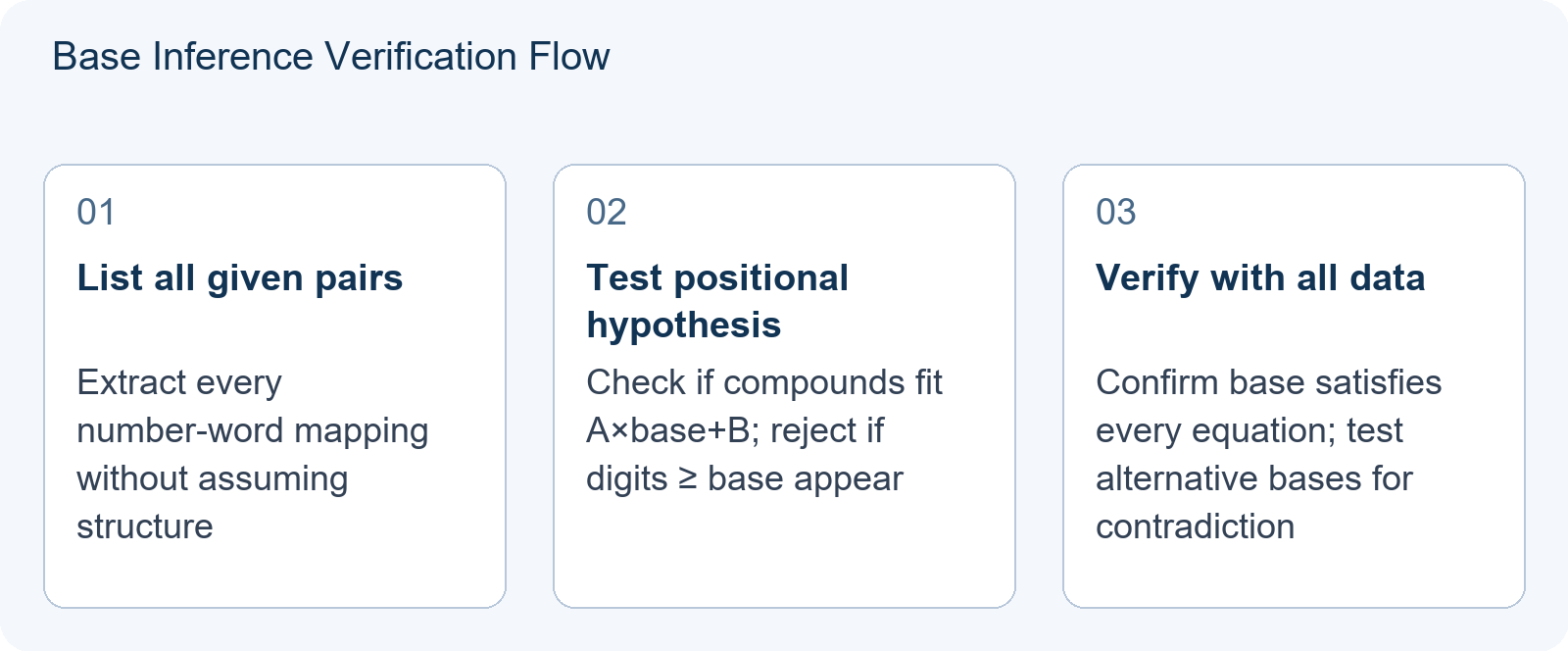
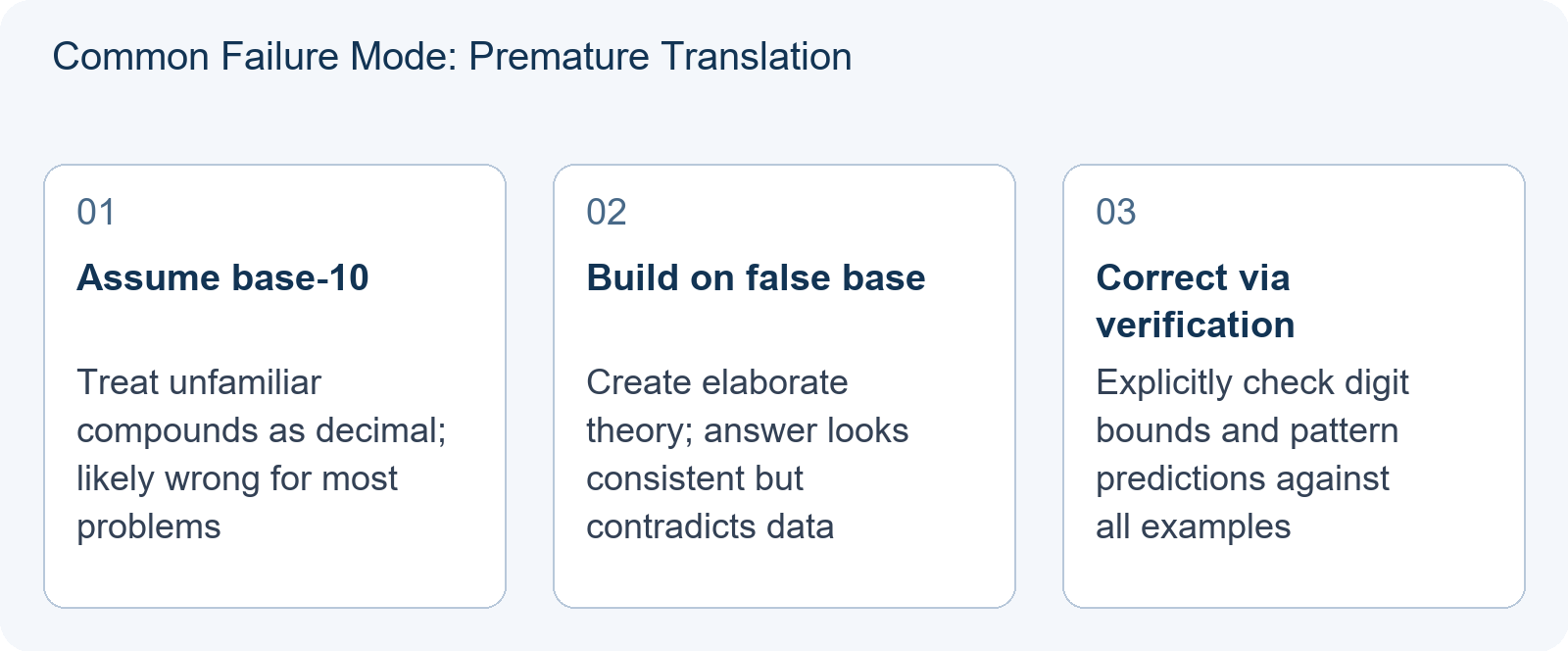
When a Linguistics Olympiad problem presents an unfamiliar number system, the most common mistake is to assume the base and start translating immediately. The correct first move is to infer the base from the given correspondences, verify that inference with multiple data points, and only then attempt a large-number translation. This article works through the exact decision process named in the title: infer the base before translating a large number.
Why Number System Problems Reward Patience Over Pattern Matching
Number system problems at the IOL and its national affiliates—NACLO in North America, IOLC in China—typically provide a small set of number words and their translations, then ask for a larger number. The challenge is not arithmetic speed but logical reconstruction. These problems appear regularly in regional and national rounds, often as one of the four to six problems on a paper. The 2027 IOL will be held in Bangkok, Thailand from July 21 to July 28, 2027, with the same competition format as prior years.
The key insight from competition practice is that students who rush to translate large numbers without verifying the base often produce answers that are internally consistent but wrong. The problem designer expects you to treat the base as an unknown variable to be solved for, not as a given.
Step 1: Extract All Given Correspondences and List Constraints
Consider the following artificial language constructed for teaching illustration:
- 1 = pa
- 2 = tu
- 3 = ci
- 4 = fo
- 5 = hand
- 10 = tu-hand
- 13 = tu-hand-ci
- 16 = ci-hand-pa
- 24 = fo-hand-fo
Your first task is to determine what number system this is. Let us examine the structure of compounds. The form tu-hand corresponds to 10. If tu = 2 and we suspect hand marks a base, then 2 × 5 = 10 suggests base 5. But we need more data to confirm the pattern and establish the rule.
Consider tu-hand-ci = 13. Testing the hypothesis that compounds follow a-hand-b = (a × base) + b: with base 5, this gives 2 × 5 + 3 = 13. Similarly, ci-hand-pa = 16 gives 3 × 5 + 1 = 16. And fo-hand-fo = 24 gives 4 × 5 + 4 = 24.
The emerging pattern is: a-hand-b = 5a + b, where hand marks the base-5 place, a is the multiplier, and b is the remainder. The constraints are a ∈ {1,2,3,4} and b ∈ {1,2,3,4}—there is no zero morpheme in this system. The word hand alone represents 5, which is consistent with the pattern when a=1 and the remainder is implicit; the atomic word for the base does not exclude that base value.
Step 2: Infer the Base Algebraically and Prove It
We can solve for the base directly using the given data. From tu-hand-ci = 13:
2b + 3 = 13, where b is the base.
Solving: 2b = 10, so b = 5.
Verify with ci-hand-pa = 16:
3b + 1 = 16, so 3b = 15, and b = 5. ✓
Verify with fo-hand-fo = 24:
4b + 4 = 24, so 4b = 20, and b = 5. ✓
The base is definitively 5. This is a spoken compositional numeral system, not a positional digit system. The word hand alone represents 5 (the base), and compounds of the form a-hand-b represent 5a + b. The atomic words for 1–4 and the base word hand are the building blocks; there is no separate word for zero. The presence of an atomic word for the base value does not exclude that value from being the base—rather, it confirms it.
Step 3: Verify with a Contrasting Case Where the Wrong Base Fails
Suppose we had incorrectly guessed base 4. We would test: does tu-hand-ci = 13 fit 2 × 4 + 3 = 11? No—11 ≠ 13. Does ci-hand-pa = 16 fit 3 × 4 + 1 = 13? No—13 ≠ 16. Every data point contradicts base 4.
What if we tried base 6? Then tu-hand-ci = 2 × 6 + 3 = 15 ≠ 13. Contradiction. Base 7? 2 × 7 + 3 = 17 ≠ 13. Contradiction.
Only base 5 satisfies all three equations simultaneously. This is the critical verification step: a single contradiction falsifies the hypothesis. Many students miss this and build elaborate theories on false foundations.
The structural reason base 4 fails is deeper than arithmetic. In a true base-4 positional system, the digit 4 would not exist as a single symbol; the digits would be 0, 1, 2, 3. Here, fo = 4 is an atomic word, and it appears in compounds like fo-hand-fo. This does not exclude base 5—it confirms that we are dealing with a compositional spoken system where the base word hand marks the place value, not with positional digits in the mathematical sense. The atomic word for a number does not cease to exist when that number serves as the base.


Step 4: Translate Numbers Within the Verified Range
Given the verified base-5 system, how would we express 23?
First, decompose 23 in base 5: 23 = 4 × 5 + 3 = 20 + 3.
Using the pattern a-hand-b = 5a + b, with a = 4 = fo and b = 3 = ci:
23 = fo-hand-ci
This is fully determined by the data and the inferred rule. No ambiguity exists because 23 < 25 (5²), so only one hand-compound is needed. This number falls within the range of the given data’s structure.
Step 5: Flag the Limits—Do Not Extrapolate Unseen Recursion as Proven
Now consider a larger number: 78. This exceeds 25 (5²), so the single-hand pattern alone is insufficient. The given data only covers numbers up to 24, so we must be explicit about what is proven versus what is hypothesized.
If the problem introduced a new lexeme—say, basket = 25—then we could express 78 as:
78 = 3 × 25 + 3 = 75 + 3, which would be ci-basket-ci (with basket taking the same compound structure as hand).
However, this is an unverified extrapolation. The data does not establish that the system recurses in this way. A rigorous answer must state: “Assuming the pattern extends with a new unit basket = 25 and the same compound structure, 78 = ci-basket-ci. This extrapolation is not proven by the given data, which only establishes the pattern up to 24.”
The key skill is to flag ambiguity explicitly rather than guess. In competition, partial credit is often awarded for correct reasoning even when the final answer differs due to genuine ambiguity. Never hide uncertainty—state it and explain what additional data would resolve it.
Step 6: Apply the Diagnostic to Your Own Preparation
After working through this teaching illustration, ask yourself:
- Did I verify the base with multiple data points, or did I assume it?
- Did I check for contradictions (like testing base 4 and showing it fails)?
- Did I distinguish compositional spoken numerals from positional digits?
- Did I flag where the data ends and my extrapolation begins?
Students who systematically check these four points score more consistently on number system problems than those who rely on intuition. The IOL-AI 2026 benchmark demonstrated that even advanced AI models struggle with multi-step verification in linguistic reasoning, confirming that this human skill remains competitively valuable.
What to Do Next Based on Your Diagnostic Result
If you found the worked case straightforward but worry about time pressure: practice with past IOL number system problems under timed conditions. IOL Past Problems: Choosing Practice Sets and Requesting Explanations describes how to select problems by difficulty and request worked solutions.
If you were unsure about the non-positional interpretation: review how different cultures construct number words. Linguistics Olympiad Minimal Pairs: Finding the Contrast That Explains the Data covers analytical techniques that transfer to number system analysis, particularly how minimal contrasts reveal structural patterns.
If you want to understand how number system problems fit into the broader competition: Linguistics Olympiad Underdetermined Data: Knowing What Your Solution Has Not Proved discusses the epistemic limits of linguistic inference, which directly applies to when you can and cannot trust your base inference.
For a family considering IOLC preparation, the concrete next step is to obtain recent number system problems and attempt them with the verification protocol above. Number systems appear in most years’ papers, making this a high-return preparation focus. The IOL official website confirms the 2027 Bangkok competition dates as July 21–28, with national rounds selecting teams in the preceding months.
Interpreting the Diagnostic: From Pattern Recognition to Structural Proof
The previous steps established a verified base-5 system using the artificial language data. However, solving the puzzle is only half the competition task; explaining why your solution is correct and where it fails is what earns full marks. Many students lose points not because their arithmetic is wrong, but because their logical justification is incomplete or overreaches.
Consider the diagnostic question from Step 6: “Did I distinguish compositional spoken numerals from positional digits?” This distinction is critical for interpreting the data correctly. In a standard positional system (like decimal), the digit ‘5’ does not exist as a single symbol in the ones place; it triggers a carry-over to the tens place. In our artificial language, however, hand (5) appears as an atomic word and also functions as a multiplier marker in compounds like tu-hand (10). If you incorrectly assume this is a strict positional system with digits 0–4, you might expect a separate word for zero or a different structure for 10. The fact that tu-hand = 10 without a zero morpheme confirms we are dealing with a compositional additive-multiplicative system, common in many natural languages (e.g., Mandarin Chinese’s shi for ten, bai for hundred).
Let us apply this interpretation to a new hypothetical case to test your understanding. Suppose the problem provides additional data:
- pa-hand-pa = 6
- tu-hand-tu = 12
Using our verified rule a-hand-b = 5a + b:
For pa-hand-pa: 1 × 5 + 1 = 6. ✓
For tu-hand-tu: 2 × 5 + 2 = 12. ✓
This consistency reinforces the model. Now, imagine a student claims that hand simply means “plus” and tu means “two,” so tu-hand is just “two plus something.” This interpretation fails because it cannot explain why ci-hand-pa is 16 rather than 3 + 1 = 4. The multiplicative relationship (5a) is essential. When writing your answer sheet, explicitly state: “The data supports a multiplicative-additive structure where the base unit hand multiplies the preceding numeral by 5, then adds the following numeral.”
A common error is extrapolating beyond the proven range without qualification. As noted in Step 5, if asked for 78, you must flag that the existence of a higher-order unit (like basket = 25) is an assumption. A strong response would be: “Based on the provided data, the system is proven up to 24. To express 78, one must hypothesize a recursive pattern where a new lexeme represents 25. Assuming such a lexeme exists and follows the same compound structure, 78 would be expressed as [multiplier]-[new-unit]-[remainder]. Without evidence of this recursion, the translation remains indeterminate.”
This level of precision—distinguishing between proven facts and necessary assumptions—is what separates high-scoring solutions from average ones. It demonstrates that you understand the limits of your inference, a core skill in linguistic analysis.
Frequently Asked Questions
How do I know if a number system is positional or compositional during a competition?
Check if the system uses a fixed set of digits strictly less than the base, with place value determined by position. In the worked example, hand is a base-word marker, not a positional digit, and compounds follow 5a + b, not place-value position. Also verify: does a-hand-b always equal a×base+b? If any compound violates this, consider non-positional alternatives like the multiplicative-additive system shown here. The atomic word for the base (hand=5) does not exclude that base value.
What if I cannot determine the base with certainty from the given data?
State your assumed base explicitly, show how the data supports it, and note any ambiguities. In IOL problems, partial credit is often awarded for correct reasoning even if the final answer differs due to genuine ambiguity. Never hide uncertainty—flag it and explain what additional data would resolve it. For numbers beyond the given range, explicitly state that you are extrapolating and identify where the inference becomes unverified, as with the basket=25 example for 78.
Where can I find practice number system problems with verified solutions?
The IOL official website at ioling.org provides past problems from previous competitions. For structured practice with solution explanations, refer to IOL Past Problems: Choosing Practice Sets and Requesting Explanations on this site. When practicing, apply the verification protocol in this article: infer the base algebraically, check for contradictions including testing alternative bases, and only then attempt large-number translations.
Keep reading.
IOLC Consonant Digraphs: Why bh, mb and ng Stay Single Units in Rongga-Style Data
In the 2026 IOLC Newcomer/Junior Division Rongga problem note, bh, mb and ng are recorded as consonants. Learn a data-first method for…
IOLC Team Average: How Each Participating Member Changes the Score
Understand how the IOLC team average is calculated from the individual scores of actual participating members, how adding or removing a member…
IOLC 2027 Level Test: Run a 3-Hour, 4-Problem Mock Before March 7
Prepare for the IOLC 2027 Level Test (March 7) by simulating the latest source-backed 2026 regional format: three hours, four independent puzzles….